


Learn chess
How to Play Chess for Beginners
All the rules in seven steps
Everything you need for your first game of chess: the setup, how every piece moves, check and checkmate, and the three special moves. There's a board for every rule and two positions you can solve right here.
Chess is a game for two players, one with the white pieces and one with the black. The board is 64 squares, half light and half dark, and each player starts with sixteen pieces: one king, one queen, two rooks, two bishops, two knights and eight pawns. White always moves first, then the players take turns, one move each. Trap your opponent's king so that it is attacked and cannot escape. That position is called checkmate, and it wins the game on the spot.
Step 1: Set up the board
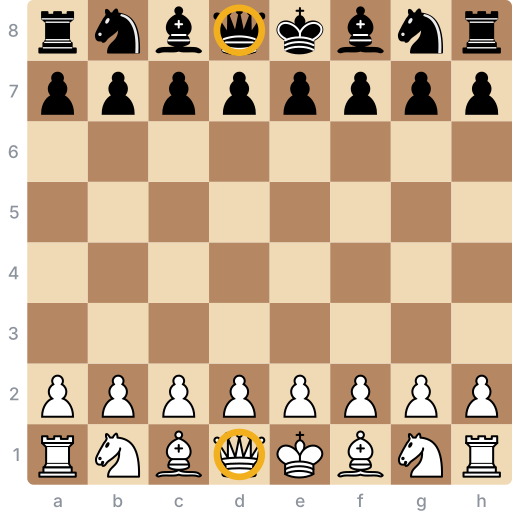
Place the board so each player has a light square in the corner on their right. The back row fills from the corners inward: rook, knight, bishop, then the queen and king on the two centre squares. The one rule people forget is the queen: she always starts on her own color, the white queen on the light square d1, the black queen on the dark square d8. The king takes the square beside her, and the eight pawns fill the second row. If you want every step with its own diagram, there's a dedicated chess board setup guide.
Step 2: Learn how each piece moves
There are six kinds of pieces and each moves in its own way. When your piece lands on a square occupied by an enemy piece, it captures it, and the captured piece leaves the board. You can never land on a square occupied by one of your own.
The king
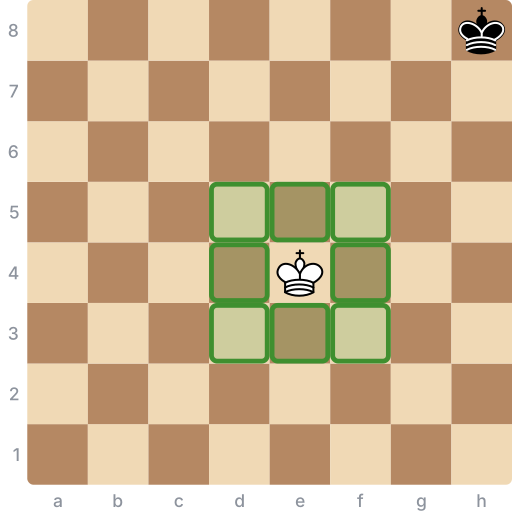
The king moves exactly one square in any direction, straight or diagonal. He is the most important piece on the board: lose him and you lose the game. The king may never move to a square that an enemy piece attacks.
The queen
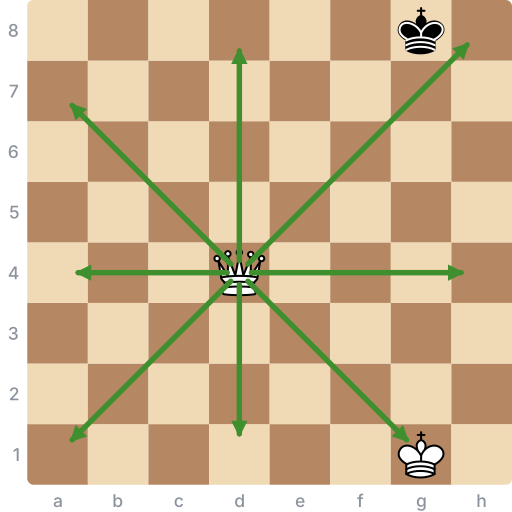
The queen is the most powerful piece. She moves any distance in a straight line: forward, backward, sideways or diagonally. The only thing that stops her is another piece in the way; she cannot jump.
The rook
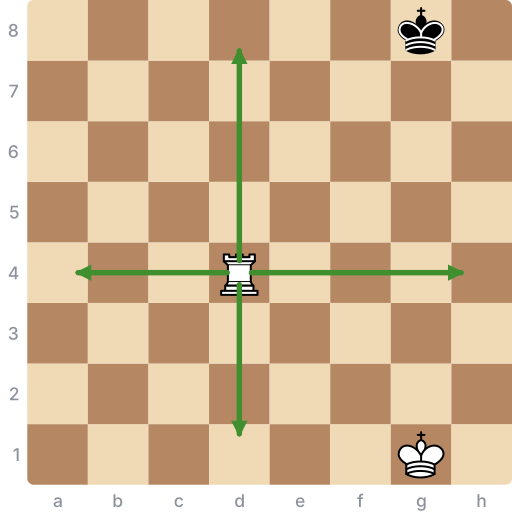
The rook moves any distance in straight lines: up, down, left or right. You have two, starting in the corners. A rook on an open board attacks fourteen squares from any square. King and rook against a lone king is a forced mate, which is why rook endgames decide so many games.
The bishop
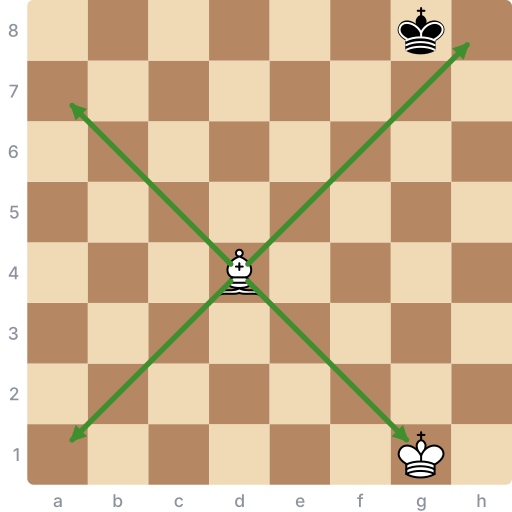
The bishop moves any distance, but only along diagonals. That means each bishop spends the entire game on one color: one of yours lives on the light squares, the other on the dark. Together they cover the whole board.
The knight
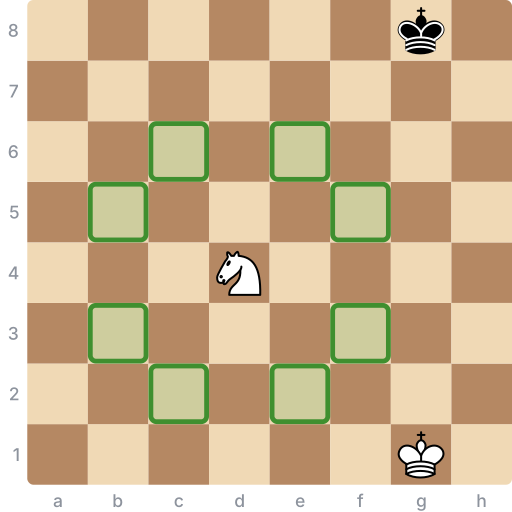
The knight moves in an L: two squares in one direction, then one square to the side. It is the only piece that jumps: pieces standing in its path make no difference at all. A knight always lands on the opposite color from the square it left; from the centre it has eight squares, from a corner only two.
The pawn
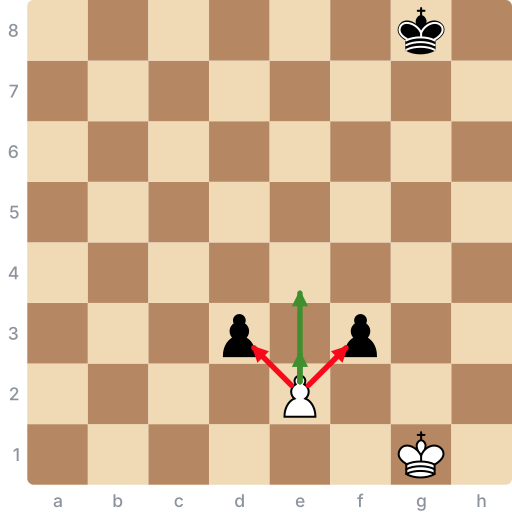
The pawn moves one square forward, or two on its very first move. But it captures differently: one square diagonally forward. A pawn can never move backwards, so every pawn move is permanent. A pawn that reaches the far end of the board becomes a queen, rook, bishop or knight on that same move. That rule is called promotion, and it's covered below.
Step 3: Check and checkmate
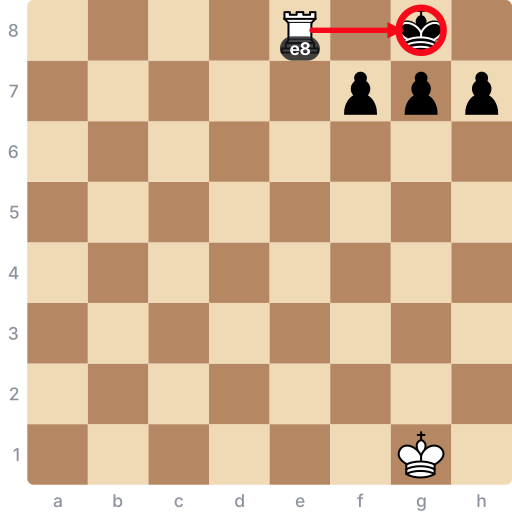
When a piece attacks the enemy king, that's check. Check must be answered on the very next move, and there are only three possible answers: move the king to a safe square, block the attack with another piece, or capture the attacker. If none of the three is possible, it's checkmate and the game ends immediately. The king is never actually captured; the trap itself is the end of the game. The diagram shows the pattern you'll see most often: a back-rank mate, where the king is fenced in by his own pawns. Four more patterns, each with a board, are in the checkmate guide.
Step 4: The three special moves
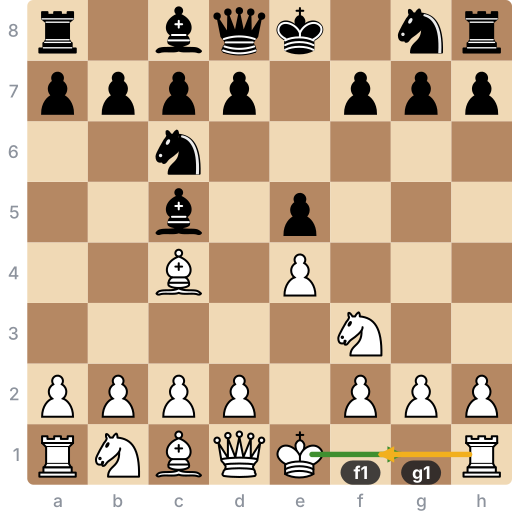
Castling moves your king two squares towards a rook while the rook hops to the king's other side: one move, two pieces. It's allowed only if neither the king nor that rook has moved yet, the squares between them are empty, and the king is not in check and doesn't pass through an attacked square. You can castle once per game, and doing it early is almost always right, because it tucks your king into safety. The full rules, kingside vs queenside, are in the castling guide.
Promotion: a pawn that reaches the last rank immediately becomes a queen, rook, bishop or knight, and nearly everyone chooses a queen. And en passant is the rare one: when an enemy pawn uses its two-square first move to land directly beside your pawn, you may capture it as if it had moved only one square, but only on the very next move. The three conditions and a board to try it on are on the en passant page.
Step 5: How games end without a winner
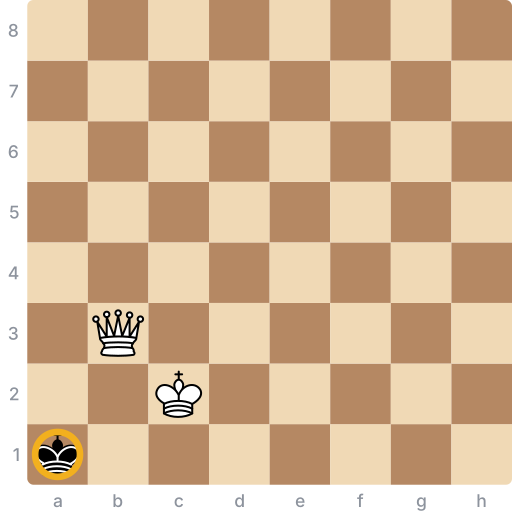
Not every game ends in checkmate. If the player to move has no legal move but their king is not in check, that's stalemate: a draw, even if the other side has an army left. Games are also drawn by agreement, by repeating the same position three times, or when neither side has enough pieces left to ever deliver mate. The practical lesson for beginners: when you're winning big, always leave the enemy king one legal move until the mate is actually there. The full list of draw rules is on the chess rules page, and stalemate vs checkmate unpacks the difference with a position where one queen move mates and another draws.
Step 6: Five habits for your first game
That's all the rules. Before you play, five habits that win beginner games:
- 1.Fight for the four centre squares (d4, d5, e4, e5). Pieces do their best work from the middle.
- 2.Bring your knights and bishops out early. A piece still on its starting square isn't playing.
- 3.Castle by move ten: the king behind three unmoved pawns is safe from most early attacks.
- 4.Don't bring your queen out too soon. Your opponent gains free moves by attacking her.
- 5.Before every move, pause one second: what did your opponent's last move attack?
Beginner games are decided by pieces left hanging, so before every move, check every piece your opponent's last move attacks. When you're ready to go deeper into the first ten moves, the best chess openings for beginners series picks up exactly here. Two openings that beginners meet in almost every game are the Italian Game (1.e4 e5 2.Nf3 Nc6 3.Bc4) and the Queen's Gambit (1.d4 d5 2.c4).
Step 7: Try it yourself
Two positions to solve on the board: the knight's L-move, then a mate in one.
The knight stands on d4. Use its L-shaped move to reach e6.
Tap a piece, then tap where it should go.
Your queen is on h5 and f7 is weak. Deliver checkmate in one move.
Tap a piece, then tap where it should go.
Beginner questions
How long does it take to learn chess?
The rules take about thirty minutes, and this page covers all of them. Being comfortable takes a few games. Play your first game right after reading and the moves settle much faster than they do from reading alone.
What is the goal of chess?
Checkmate: trap your opponent's king so it is attacked and has no way out of the attack. The king is never actually captured: the moment no escape exists, the game is over and the attacker has won.
Who goes first in chess?
White always moves first, and the players alternate one move at a time after that. In casual play you draw for colors or take turns; in tournaments the pairings assign them.
Is chess hard to learn?
No. There are six kinds of pieces, three special moves, and one goal, all of which fit on this page. Chess is hard to master, which is a different thing.
How does the knight move?
In an L-shape: two squares in a straight line, then one square to the side, giving up to eight landing squares from the middle of the board. The knight is also the only piece that jumps: pieces in its path, yours or your opponent's, make no difference.
Can I learn chess by myself?
Yes. Read the rules, then play. Install the free Zapp Chess app; the board only allows legal moves, so it quietly teaches you the rules as you play.
Keep going: what chess is, chess rules, chess board setup, step by step, chess strategies for beginners and how to analyze chess games, once you have played a few. Next page: pass and play chess with a friend on one phone. When you are ready to play online, our best chess app comparison covers price, free-tier limits and game length.
This page in other languages: தமிழ் · हिन्दी · Hinglish · বাংলা · मराठी · Deutsch · Tiếng Việt · Polski · Bahasa Indonesia · Русский · ไทย · Italiano · Français · Türkçe · Español · Português · العربية
