


Chess rules
Chess Rules
Setup, piece moves, special moves, check, checkmate and draws
The rules of chess: the setup, how each piece moves and captures, the three special moves, check and checkmate, and all five ways a game can end in a draw.
Every rule below serves one goal, checkmate: a king in check with no legal way out. The checkmate rules and mating patterns page states the rule exactly, gives a four-point checklist for deciding whether a position is mate, and shows thirteen named mating patterns, from back-rank mate to fool's mate, with a board for the most common ones.
Board and setup rules
The board sits so that each player has a light square in their right-hand corner. The back row fills from the corners inward: rook, knight, bishop, then queen and king. Each queen starts on her own color, the white queen on the light square d1, the black queen on the dark square d8. Eight pawns stand on each player's second row. White moves first, and the players alternate one move at a time. You must move on your turn (passing is not allowed), and you move exactly one of your own pieces (castling is the one exception). Every step is shown square by square in the chess board setup guide.
How the pieces move: the reference table
| Piece | Moves | Captures | Worth |
|---|---|---|---|
| King | One square in any direction | Same as it moves; never onto an attacked square | The game |
| Queen | Any distance in all eight directions | Same as she moves | 9 points |
| Rook | Any distance in straight lines | Same as it moves | 5 points |
| Bishop | Any distance along diagonals | Same as it moves | 3 points |
| Knight | An L-shape: two squares, then one across; jumps over pieces | Same as it moves | 3 points |
| Pawn | One square forward; two on its first move; never backwards | One square diagonally forward | 1 point |
Capturing means moving your piece onto a square occupied by an enemy piece, which then leaves the board. Only the pawn is odd: it moves straight but captures diagonally. The point values are a rough guide for trades, covered properly in chess piece values. To learn the moves with a board for each piece, use the how to play chess for beginners tutorial, and to read and write moves like Nf3 or O-O, see chess notation.
The three special moves
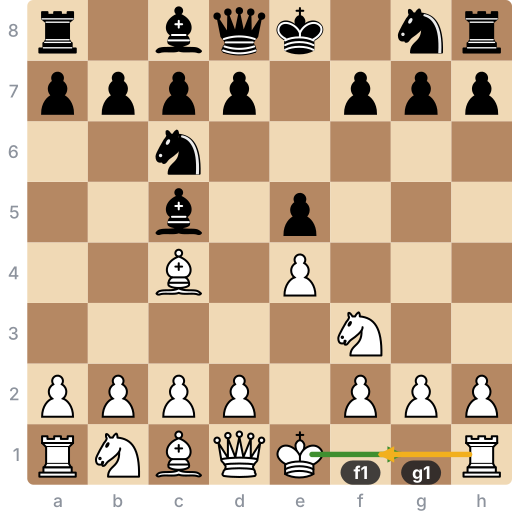
Castling: in a single move, the king jumps two squares towards a rook and the rook lands on the king's other side. Four conditions, all required:
- 1.The king has not moved yet in the game.
- 2.That rook has not moved yet either.
- 3.Every square between the king and the rook is empty.
- 4.The king is not in check, does not pass through an attacked square, and does not land on one.
The rook being attacked is fine; the restriction applies only to the king's squares. Kingside vs queenside, the notation, and when to castle are all in the castling guide, with a position to castle in yourself.
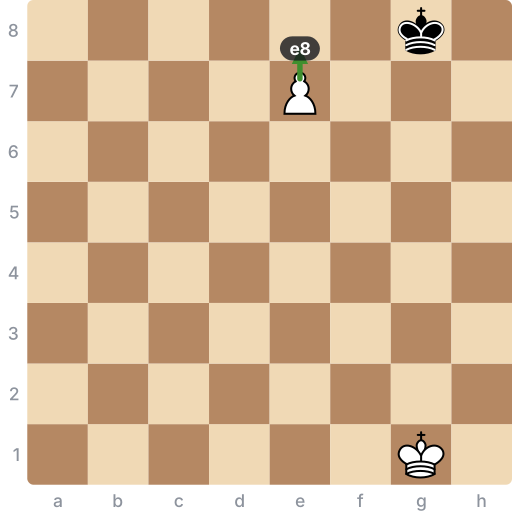
Promotion: a pawn that reaches the last rank (the 8th for White, the 1st for Black) becomes a queen, rook, bishop or knight on that same move. A queen is almost always the right choice, and already having one is no obstacle: two or three queens are perfectly legal.
En passant: when an enemy pawn's two-square first move carries it directly beside your pawn, you may capture it as if it had moved only one square, but only on the very next move. The three conditions and a board to try it on are on the en passant page.
Check, checkmate, stalemate
Check means your king is attacked. You must answer it on that very move: move the king, block the attack, or capture the attacker. You may never make a move that leaves your own king in check. Checkmate means the king is attacked and all three answers are impossible: the game ends there, and the attacker wins. The king is never captured; the trap itself ends the game. The checkmate guide shows the five mating patterns that end most beginner games, with a board for each, and seven more named mates.
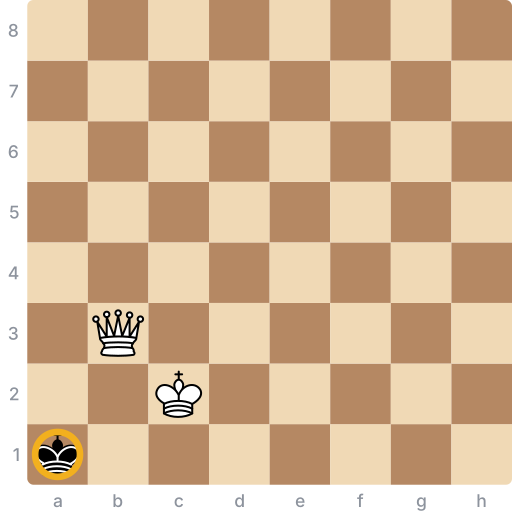
Stalemate is different: the player to move has no legal move, but their king is not in check. That is not a win. It's a draw, and it's the most common accident for the winning side, so when you're far ahead, always leave the enemy king one legal move until the mate is actually delivered. The full comparison lives in stalemate vs checkmate, with a position where one queen move mates and another draws.
The draw rules, complete
A game of chess can end in a draw in five ways:
- 1.Stalemate.
- 2.The players agree to a draw.
- 3.The same position occurs three times (threefold repetition).
- 4.Fifty consecutive moves pass with no capture and no pawn move (the fifty-move rule).
- 5.Neither side has enough material left to ever deliver mate: king against king, or king and a lone bishop or knight against king (insufficient material).
Touch move and illegal moves
The tournament rule: touch one of your pieces and you must move it if it has a legal move; touch an enemy piece and you must capture it if you can. If you only want to straighten a piece, say so first; the word is "j'adoube", or simply "adjusting". Casual games at home often relax this, but agree the touch-move rule before a casual game, because tournaments always apply it. If an illegal move is played, the position is restored and a legal move must be made instead. Online, none of this comes up: the board simply won't let an illegal move happen. Two people sharing one phone are somewhere in between; the house rules for pass and play chess on one phone cover that case.
Common questions
Can a pawn move backwards?
Never. The pawn is the only piece that cannot retreat, which is why every pawn move is permanent. Think before you push one.
Can you have two queens in chess?
Yes. When a pawn reaches the last rank it promotes, and it can become a queen even if you still have your original one. Two, three, or more queens are all legal.
Who wins in a stalemate?
Nobody. Stalemate is a draw. If the player to move has no legal move and their king is not in check, the game ends immediately with half a point each.
Is castling mandatory?
No, castling is optional. It is usually the best way to make your king safe, though, so strong players castle in almost every game.
Can the king capture pieces?
Yes. The king captures the same way it moves, one square in any direction. The only restriction is that it can never move onto a square an enemy piece attacks, so it can only capture pieces that are undefended.
Go deeper: what chess is, how to play chess for beginners, chess board setup with a diagram for every step, checkmate and thirteen named mating patterns and en passant. If you enjoy the rules of chess and want its relatives, Shogi, Go and six more are on games like chess.
This page in other languages: தமிழ் · हिन्दी · Hinglish · বাংলা · मराठी · Deutsch · Tiếng Việt · Polski · Bahasa Indonesia · Русский · ไทย · Italiano · Français · Türkçe · Español · Português · العربية
