


The Tech Mahindra Global Chess League runs in Bengaluru from 5 to 13 September 2026 — the schedule, live points table and results are on the Global Chess League 2026 page.
Chess guide: rules, tactics and Zapp Chess
About Chess
Chess is about fifteen centuries old: it comes from chaturanga, played in India around the sixth century. The modern queen and bishop moves date from the late fifteenth century in Europe; castling, en passant and stalemate as a draw were standardised by the nineteenth century, and the rules have not changed since.
The rules take about thirty minutes to learn. A classical tournament game can take four hours or more; a Zapp game starts from a mid-game position and ends within minutes.
What a tactic is
A tactic is a short forcing sequence that wins material or delivers checkmate. Example: a knight on c7 attacks the king on e8 and the rook on a8 at the same time (a fork); the king must move and the rook is lost. Tactics like this decide most games below club level, and they are found by looking at the board, not by memorising.
Why Zapp
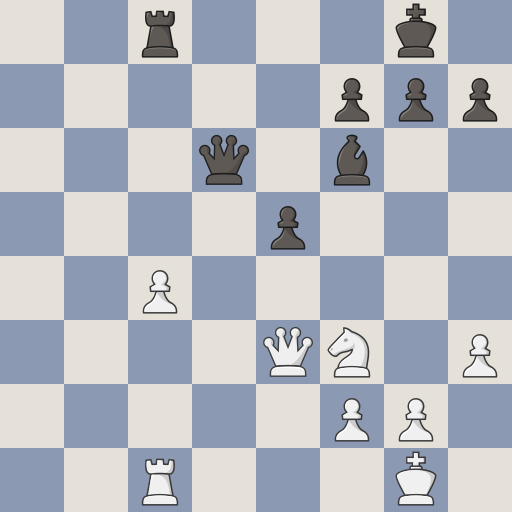
A Zapp Chess game starts from a curated mid-game position and lasts five to ten half-moves. There is no opening phase and no opening theory to learn: the pieces are already in contact, and the game is decided by the tactics in the position.
A game takes a few minutes, so it fits a commute, a lunch break or the time before bed. You improve by playing often and checking every move for threats, not by drilling theory.
Play Free
Zapp Chess is a free app for Android and iPhone. Install it from Google Play or the App Store and start a game.
- Free to play — every game, no cost.
- Free to install — no purchase, no subscription.
- Play real people — every game is against another player.
- Fast games — each game starts from a mid-game position and ends within minutes.
Openings for beginners
You do not need to learn opening lines to start playing. An opening line is a memorised sequence of the first ten to fifteen moves; a beginner who skips it and follows the habits in the next section (centre, active pieces, king safety, no free pieces) reaches a playable middlegame. A Zapp game starts from a mid-game position, so it has no opening phase at all.
How to win more games (things you'll notice as you play)
Six checks that decide most beginner games:
- The center matters. A knight on e4 attacks eight squares; on a1 it attacks two. Put knights and bishops on or near d4, d5, e4, e5.
- Idle pieces lose games. Watch how often a game is decided by the pieces already in the fight while half the loser's army never moved. The more of your pieces are actually doing something, the better things tend to go.
- A king in the open is a target. Castle early. A king on e1 stands on the e-file, which opens as soon as the e-pawn advances, and on the e1-h4 diagonal; a castled king on g1 stands behind the f2, g2 and h2 pawns.
- Don't give pieces away. Before every move, check: is the piece I'm moving protected? Am I leaving anything hanging? Most beginner games are decided by simple blunders, not brilliance.
- Look at your opponent's last move. Every time they move, ask why. What are they threatening? Half of defense is just noticing the threat before it lands.
- Think before you move — especially before captures. When you can take a piece, pause. Is it a gift or a trap? A three-second check saves a lot of lost games.
For each of these habits with an example board, read chess strategies for beginners.
Rules
The rules, in order: board setup, piece moves, checkmate, the three special moves, draws. For the board, the pieces, the goal and a short history of the game, read what is chess.
- The board. Chess is played on an 8×8 grid of 64 squares. Set it up so each player has a white (light) square in their bottom-right corner. Each side starts with 16 pieces: eight pawns along the second row, and behind them — from the corners inward — two rooks, two knights, two bishops, then the queen and king. The queen goes on her own color (white queen on a light square, black queen on a dark one). White moves first, and players alternate turns.
- How the pieces move.
- Pawn — moves forward one square (or two on its first move), but captures diagonally. It can't move backward.
- Rook — moves any number of squares in a straight line, horizontally or vertically.
- Bishop — moves any number of squares diagonally, staying on one color all game.
- Knight — moves in an "L": two squares one way and one square at a right angle. It's the only piece that jumps over others.
- Queen — the most powerful piece: moves any number of squares in any direction — straight or diagonal.
- King — moves one square in any direction. The king may never move to an attacked square; if it is attacked and cannot escape, the game is lost.
- The goal: checkmate. When a king is under attack, it's in check, and that threat must be answered immediately — by moving the king, blocking the attack, or capturing the attacker. If there's no legal way out of check, it's checkmate, and the game is over. Checkmating your opponent's king is how you win.
- A few special moves.
- Castling — a one-time move that tucks your king to safety. If neither the king nor a rook has moved and the squares between them are empty, the king slides two squares toward the rook and the rook hops to the king's other side.
- En passant — a special pawn capture. If an opponent's pawn advances two squares and lands beside yours, you may capture it as if it had moved only one — but only on the very next move.
- Promotion — get a pawn all the way to the far side of the board and it transforms into any piece you choose, almost always a queen.
- Draws. Not every game has a winner. A game is drawn if a king isn't in check but has no legal move (stalemate), if neither side has enough material to checkmate, by repetition of the position, or by agreement.
Tactics
Tactics are the short, forcing sequences that win material or deliver checkmate. Each one below is a pattern with a fixed shape; once you know the shape, you find it on the board by looking for the pieces it needs. The essential ones:
- Fork — one piece attacks two or more of your opponent's pieces at once, so they can only save one.
- Pin — a piece can't move because doing so would expose a more valuable piece behind it.
- Skewer — like a pin in reverse: a valuable piece is attacked and forced to move, exposing a lesser piece behind it.
- Discovered attack — moving one piece unveils an attack from another piece behind it.
- Double attack — two threats created at the same time, more than your opponent can answer.
- Sacrifice — deliberately giving up material to open lines, expose the king, or force a winning sequence.
- Back-rank mate — a checkmate delivered along the opponent's back row, where their own pawns trap the king.
- Deflection — forcing a defending piece away from the square or piece it was guarding.
- Decoy — luring an enemy piece onto a bad square where it can be attacked or exploited.
- Zwischenzug — an "in-between move": instead of the expected recapture, you insert a more forcing move first.
- Windmill — a repeating sequence of checks and discovered attacks that harvests material.
- Overloading — a defending piece is given too many jobs, so it fails at one of them.
To find the tactics you missed in your own games, paste the PGN into the free chess analysis board. Stockfish runs in your browser and game review marks every blunder, mistake, and missed win.
Ready to play? Start a game.
Chess events
Guides to the big tournaments, with dates, formats and where to watch.
- Global Chess League 2026 — 5 to 13 September 2026, Bengaluru
- Chess Olympiad 2026 — 15 to 27 September 2026, Samarkand
- US Chess Championship 2026 — 9 to 21 October 2026, Saint Louis
- European Club Cup 2026 — 16 to 24 October 2026, Herceg Novi
- World Chess Championship 2026 — 24 November to 12 December 2026, Geneva
- World Rapid and Blitz Championship 2026 — late December 2026
- Tata Steel Chess 2027 — January 2027, Wijk aan Zee
- FIDE Freestyle Chess World Championship 2027 — 12 to 14 February 2027, Weissenhaus
- Prague Chess Festival 2027 — 16 to 26 February 2027, Prague
- Grand Chess Tour 2027 — 16 April to 4 October 2027, Bucharest to São Paulo
- FIDE Grand Swiss 2027 — 10 to 25 May 2027, Isle of Man
- UzChess Cup 2027 — June 2027, Tashkent
- International Chess Day 2027 — 20 July 2027, worldwide
- Women's World Chess Championship 2027 — Vaishali vs Ju Wenjun, 2027, dates to be announced
- Norway Chess 2027 — dates and venue to be announced
- Candidates Tournament 2028 — qualification runs through 2027, dates to be announced
- Chess World Cup 2027 — fourth quarter of 2027, host to be announced
- Tata Steel Chess India — rapid and blitz in Kolkata, next dates to be announced
- Bullet Chess Championship — Nihal Sarin won in 2026, 2027 dates to be announced
- Speed Chess Championship — Carlsen won in February 2026, 2026 dates to be announced
- Esports World Cup Chess — Carlsen won in 2026, next edition in Riyadh in 2027
- Titled Tuesday — every Tuesday on Chess.com, $10,000 in prizes
- Freestyle Chess Grand Slam Tour — Carlsen won the 2025 tour, next season to be announced
- PogChamps — Jynxzi won in 2026, next edition to be announced
- All chess events — dates and schedule for 2026-27
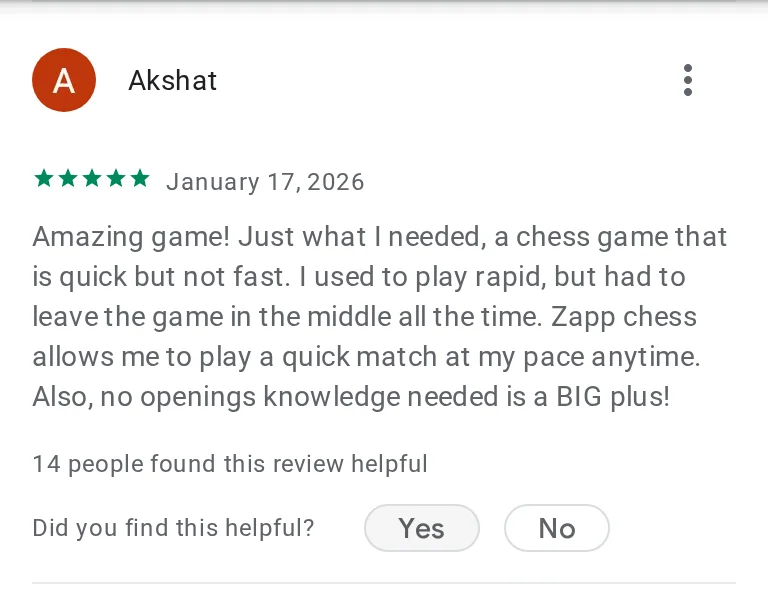
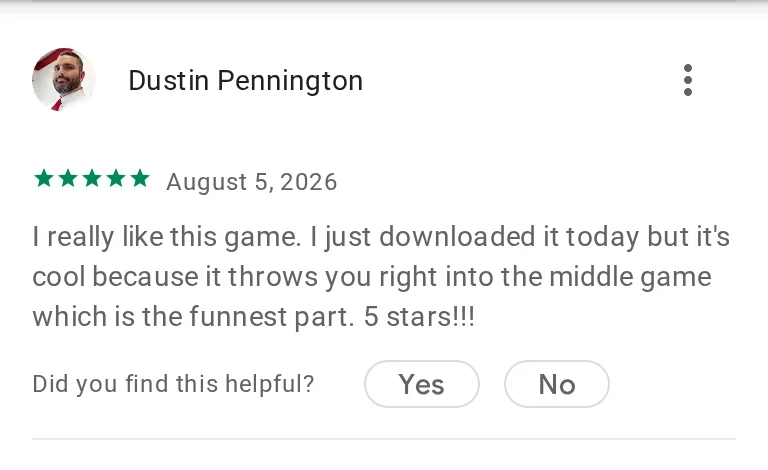
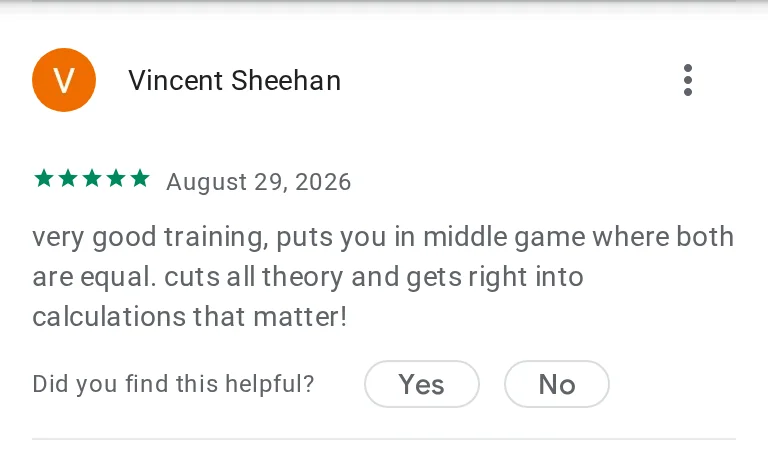
What players say on Google Play
Frequently Asked Questions
Zapp Chess is chess for your natural talent. No openings to memorize, no endgame theory to study. You win by a 2-point material lead — or checkmate. Games wrap up in under 3 minutes, but you play each move on your own time.
You win by a 2-point material lead — or checkmate. Material is calculated using standard chess piece values: Pawn=1, Knight/Bishop=3, Rook=5, Queen=9. Capture strategically!
Not at all! Zapp Chess is designed for players who want to win on pure talent. Every game starts from the middlegame, so games are decided through tactics, not memorized theory.
The player whose time runs out first loses the game. So manage your clock wisely!
Yes! Zapp Chess is free to download, and every game is free.