


Learn chess
How to Analyze Chess Games
A five-step method for reviewing your own games
Analyzing a chess game means going back through it to find the moment it turned, working out what you saw and what you missed, and taking one lesson into the next game. It takes about twenty minutes, costs nothing, and finds the one move that lost the game; the next game starts from that move, not from zero. Below: the five steps, how to read an evaluation bar in plain words, a board that shows a real swing moment, and a position to judge yourself. When you are ready, paste your game into the free analysis board and follow along.
Why analyze your own games
Most players improve by playing more, and most of them stop improving at the same place: the point where their mistakes have become habits. A game you play and forget teaches you nothing, because the mistake felt like a normal move at the time. Review means replaying your own game, move by move, and marking three things: the move where material was first lost, the move where the plan changed, and the move you were unsure about at the board.
Your own game contains the position you actually got wrong, so the fix applies directly next time. Write the lesson as one sentence with a move number, for example: move 14, I left the knight on c3 undefended before pushing d5. Review the games you won too, because a win with three mistakes in it is three lessons your opponent handed you for free.
The five-step method
You need the moves of the game and a board. The free Zapp Chess analysis board accepts a pasted PGN or FEN, plays through the moves, runs Stockfish in your browser and can review the whole game at once, with no account and nothing uploaded. Any board works for the method, though.
- 1.Get the game onto a board. Export it as PGN from wherever you played, or write the moves down from memory straight after an over-the-board game. Do this within a day, while you still remember what you were thinking.
- 2.Find the moment the evaluation swung. Play through the game once, without the engine, and mark the move where you felt the game slip. Then switch the engine on and look for the biggest drop on the graph. Usually those are the same move. If not, the engine's moment is the one to study.
- 3.Ask what you saw and what you missed. Set up the position before the swing move. Write down what you were planning, what you thought your opponent would do, and what you did not look at. The lesson is not the better move; it is the reason you did not find it.
- 4.Check the opening against a known line. Compare your first eight to ten moves with the trainer for that opening. Note the first move where you left the line, and whether it cost anything. Most beginner games are decided long after the opening, so do not spend more than a few minutes here.
- 5.Write one lesson. One sentence, in your own words, that you can apply on move one of the next game: look at every capture before I move, do not grab pawns with the queen, castle before move ten. One lesson per game, kept in a list, is the whole training plan.
For step four, compare your first ten moves with the opening page for the line you played and mark the first move that differs: chess openings for beginners explains the principles a beginner should measure their first moves against, and the opening trainers walk through the main lines move by move, so you can find exactly where your game left the road. If you do not know the name of what you played, the first moves usually settle it: 1.e4 e5 2.Nf3 Nc6 3.Bc4 is the Italian Game, 1.e4 c5 is the Sicilian Defense, 1.d4 d5 2.c4 is the Queen's Gambit, and 1.d4 d5 2.Bf4 is the London System.
How to read the eval bar and the numbers
The evaluation bar is the engine's opinion of who stands better, drawn as a white share and a black share. The number beside it is the same opinion in pawn units, always from White's point of view: +1.50 means White is about a pawn and a half better, -0.30 means Black is a little better, 0.00 is level. You will also see it written as centipawns, which are hundredths of a pawn: +150 centipawns and +1.50 are the same thing. A score like M5 means forced checkmate in five moves for White; -M3 means Black mates in three.
The engine also translates that number into a chance of winning, and that is the version worth reading. On the Zapp Chess board a score of +1.00 works out to roughly a 59 percent expected result for White, +3.00 to about 75 percent, and +5.00 to about 86 percent. Game review uses those percentages to judge each move: a move that costs you less than two points of winning chance is marked excellent, under five good, under ten an inaccuracy, under twenty a mistake, and anything worse a blunder. Best is the engine's own top choice, book is a known opening move, and miss means you had a winning shot and did not take it.
Two warnings. First, the number assumes both sides play perfectly from here, so a +0.40 edge in a wild position tells you nothing about who will win between two humans. Second, small numbers are not worth your time. Whether a move was +0.20 or +0.50 is a question for titled players. What you are looking for is the cliff: the single move where the bar jumps by two, three, six pawns. That move is your lesson.
The swing moment, on a board
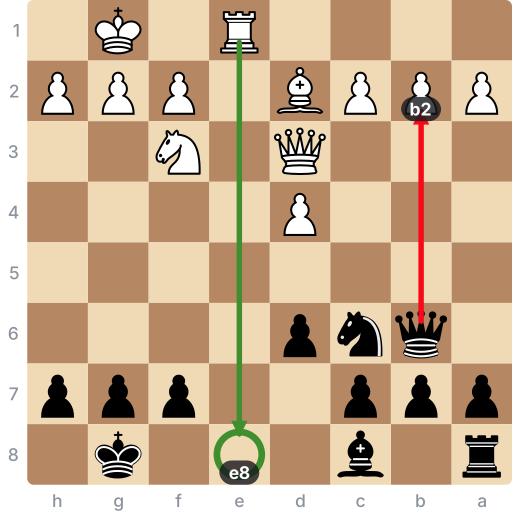
The board shows a swing of the full scale: level to mate in one in a single move. Black, to move, is doing fine: the material is level and nothing of Black's is hanging. Black sees the pawn on b2 undefended and takes it with the queen. The graph, which had been flat for twenty moves, falls off the edge of the chart. White plays Re8 and it is checkmate: the black rook cannot reach e8 past its own bishop, the pawns on f7, g7 and h7 give the king no square, and nothing else covers the back rank.
Now the three questions from step three. What did Black see? A free pawn. What did Black miss? That the threat of Re8 was already on the board before the capture and needed answering first, with ...h6 or ...Bd7. What is the lesson? Before every capture, look at every check your opponent has. Note that the punishing move was not hard to find; the swing was not about calculation but about a question that never got asked. That is true of nearly every swing in beginner games.
Evaluate this position yourself
White to move. Treat this like step three of a review: the number has told you something big just happened, and your job is to say what, in chess words, before reading any engine line.
Black has just played ...Qd7 and the bar jumped from level to well past +5 for White. Before you look at any engine line, find the move the number is pointing at.
Tap a piece, then tap where it should go.
Five mistakes analysis keeps finding
Review twenty beginner games and the swing moments sort themselves into a short list. Each mistake below has a one-line check to run before every move.
- 1.A piece left where it can be taken for free. The biggest group by far. The fix is a scan before every move: what does the last move check, capture, or threaten, and which of my pieces has no defender after my reply.
- 2.A capture that ignored a check. The pawn grab above. Captures feel like progress, so the eye stops looking once it has found one. Look at the opponent's checks first, every time.
- 3.The queen out early and chased around. Three or four queen moves in the first ten while the knights and bishops sit at home. Analysis shows the same pattern: nothing was lost, but the position was already worse on move eight.
- 4.A king that never castled. The review marks no blunder for twelve moves and then a collapse, because the king on e1 was a target the whole time. Castle by move ten unless you can name the reason not to.
- 5.A bad trade. Knight for two pawns, rook for a bishop, queen for rook and knight. Learn the piece values and the trade decisions get easier at the board.
The habits that fix the first four are the five plans in chess strategies for beginners; the fifth comes from chess piece values. If your reviews keep producing the same mistake, that page is the one to read next.
Do this with your next game
The method only works on a real game, so the next step is to play one and bring it back. Paste the PGN into the analysis board, press Review, click the biggest drop on the graph, and answer the three questions. Review one game a week for twenty minutes and keep the lessons in one list; after ten games the list shows which mistake repeats, and that is the one to work on.
For fast games that produce a lot of swing moments to study, Zapp Chess battles begin from a curated middlegame position with the pieces already developed, and the winner is the first to go two points of material ahead. Every game is five to ten moves of exactly the decisions on the list above: captures, checks, threats and trades. Play in the app, then copy the position you are not sure about into the analysis board and find out.
Game analysis questions
Do I need to pay for chess game analysis?
No. The Zapp Chess analysis board runs Stockfish inside your browser, reviews a whole game, and marks every move, with no account and no upload. The paid tiers on other sites add convenience, not a different verdict on your moves. Reviewing one game takes about twenty minutes.
What does +1.5 mean in chess analysis?
The engine thinks White is about a pawn and a half better than Black, with best play from both sides. Negative numbers favour Black, 0.00 is level, and M followed by a number means a forced checkmate in that many moves. On the Zapp Chess board +1.50 corresponds to roughly a 63 percent expected result for White.
What is the difference between a blunder, a mistake and an inaccuracy?
They are sizes of the same thing: how much winning chance a move threw away compared with the best move. On the Zapp Chess review a drop under ten percentage points is an inaccuracy, under twenty a mistake, and twenty or more a blunder. A blunder is usually a piece or the game; an inaccuracy is often a plan that was slightly worse.
Should I analyze my wins as well as my losses?
Yes. A win only proves your opponent made the last mistake. The review of a won game usually shows two or three moments where you were losing and were let off, and those are the same lessons a loss would have taught.
Should I analyze without the engine first?
For step two, yes: play through the game once on your own and mark where you felt it slip, then turn the engine on to check. Doing it in that order trains your judgement. Skipping straight to the engine tells you the answer without telling you why you did not see it, which is the part that carries over to the next game.
How do I analyze a game from chess.com or lichess?
Export or copy the game as PGN from the site where you played it, paste it into the Zapp Chess analysis board, and press Review. The move list, the evaluation graph and the classifications appear for every move; click the biggest drop and start from step three of the method.
Keep going: the free analysis board, with Stockfish in your browser, chess strategies for beginners and chess openings for beginners, for step four of the method.
