


Learn chess
What Is Chess?
Rules, pieces, objective and history of the game
Chess is a two-player strategy game on a board of 64 squares. Each side commands sixteen pieces of six kinds, the players move one piece per turn, and the game is won by trapping the enemy king so that it cannot escape capture: checkmate. Nothing is hidden and nothing is rolled, so the better decisions win. This page covers the board, the pieces, the goal, where the game came from, how a game runs from the first move to the last, and how to play one today.
Overview
Two players sit across an eight-by-eight board. One plays White, the other Black, and White moves first. On each turn you move exactly one piece; castling, which shifts the king and a rook together, is the single exception. If your piece lands on a square held by an enemy piece, that piece is captured and leaves the board. The six kinds of piece all move differently, and that difference is the whole game: a knight jumps, a bishop slides along diagonals, a pawn creeps forward one square at a time.
There is no luck. Both players see everything on the board at all times, so a game of chess is decided only by the quality of the decisions made at it. The rules fit in about thirty minutes: six piece types, three special moves, one goal. The number of possible games, about 10 to the power 120 by Shannon's estimate, is larger than the number of atoms in the observable universe, about 10 to the power 80, so no player ever runs out of new positions.
The board and the six pieces
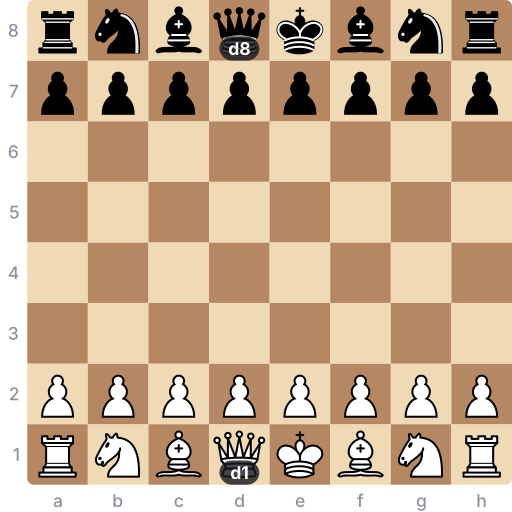
The board has 64 squares in alternating light and dark colours, set so that each player has a light square in the right-hand corner. Columns are called files and carry the letters a to h; rows are called ranks and are numbered 1 to 8 from White's side. Each player starts with the same sixteen pieces on the two nearest ranks: eight pawns in front, and behind them two rooks in the corners, two knights, two bishops, a queen and a king.
- 1.King: moves one square in any direction. It is never captured, and it is the one piece you cannot afford to lose.
- 2.Queen: moves any distance along a rank, a file or a diagonal. The strongest piece on the board.
- 3.Rook: moves any distance along ranks and files. Two per side, starting in the corners.
- 4.Bishop: moves any distance along diagonals. Each side has one on light squares and one on dark, and they never change colour.
- 5.Knight: moves in an L, two squares one way and one square across, and it is the only piece that jumps over others.
- 6.Pawn: moves one square forward, or two from its starting square, captures one square diagonally forward, never moves backwards, and becomes a queen, rook, bishop or knight when it reaches the far end.
A setup walkthrough with a diagram for every step is at chess board setup, and the guide to what each piece is worth in a trade, pawn 1, knight and bishop 3, rook 5, queen 9, is at chess piece values.
The goal: checkmate
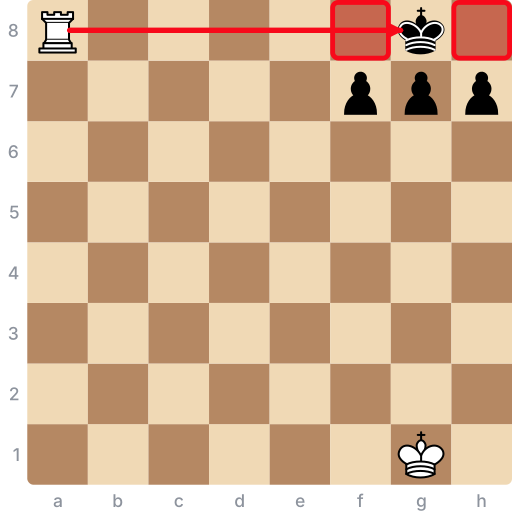
The king is never actually taken. When a king is attacked it is in check, and the player must answer the check at once in one of three ways: move the king to a safe square, put a piece in the way, or capture the attacker. When none of the three is possible, the king is checkmated and the game ends. The board shows the simplest version. White's rook on a8 attacks the black king along the back rank, the pawns on f7, g7 and h7 block the king's own escape squares, and Black has nothing that can block the rank or capture the rook. Checkmate, and the game is over.
A game can also end in a draw. The common ways: both players agree to one; the same position appears three times; fifty moves pass with no capture and no pawn move; neither side has enough material left to give mate; or the side to move has no legal move but is not in check, which is stalemate. Stalemate happens most often when the winning side has a queen next to the lone enemy king: before each queen move, count the enemy king's legal squares and leave it at least one until the mate is on the board. Stalemate vs checkmate shows the difference on boards.
A short history
The earliest written accounts of the game date from the start of the seventh century. They describe chaturanga, played in India on an eight-by-eight board, whose Sanskrit name means the four divisions of an army: infantry, cavalry, elephants and chariots, the ancestors of the pawn, knight, bishop and rook. Historians long agreed on an origin in northwest India in the early 600s; that consensus has been questioned in recent scholarship, but no earlier source has displaced it. A Persian text of the period, the Chatrang-namak, tells how the game reached the Sasanian court during the reign of Khosrow I, where it became chatrang.
After the Arab conquest of Persia in the seventh century the game became shatranj and travelled with traders and scholars across North Africa into Spain and Italy. The English words check, chess and checkmate come down that road: shah is Persian for king, and shah mat means the king is helpless. The oldest known chess manual, al-Adli's Kitab ash-shatranj, was written in Arabic around 840.
Medieval European chess was slow: the queen moved one square diagonally and the bishop exactly two. The modern moves appeared in Valencia, Spain, around 1475, when the queen and the bishop gained their long-range powers and pawns their double first step. The new game spread through Italy and France, and, a few refinements later (castling, en passant and promotion in their present form), became the game played today. The rules were fully standardised by the end of the nineteenth century.
Organised chess is a nineteenth-century invention. Wilhelm Steinitz beat Johannes Zukertort in 1886 in what is counted as the first official world championship match. FIDE, the world federation, was founded in Paris on 20 July 1924, during the first unofficial chess Olympiad, and today governs the world championship and the rating system. Its founding day is now marked every year as International Chess Day. The first internet chess server went live in 1992, and most games in the world are now played online. In 2024 the title returned to the country where the game began: Gukesh Dommaraju of India became world champion. The dates in this section follow Murray's A History of Chess (1913) and later scholarship.
How a game flows
Every game passes through the same three phases, whatever the level. In the opening, roughly the first ten moves, both players bring pieces off the back rank, fight for the four central squares and tuck the king away by castling. Named openings such as the Ruy Lopez or the Sicilian Defense are the tested move orders for this phase. In the middlegame the armies are in contact: pieces are won and lost, attacks are launched, and most games between beginners are decided here by a piece left where it could be taken for nothing. In the endgame few pieces remain, the king comes out to fight, and pawns march toward promotion.
Competitive games run on a clock. Each player has a fixed amount of time for all their moves, and running out loses. FIDE's bands: blitz gives each player ten minutes or less, rapid more than ten and under sixty, classical an hour or more. Every move can be written in algebraic notation, Nf3 for a knight arriving on the f3 square, so any game ever played can be replayed from a short line of text. Chess notation explains the whole system.
How to start today
You do not need a set or a lesson for your first game. Install Zapp Chess from Google Play or the App Store. Zapp games begin in a curated middlegame position with the pieces already developed, and the first player to go two points of material ahead wins, so a game takes a few minutes and skips the memorised opening moves entirely. Two people with one phone can use pass and play in the app and take turns on the same screen.
Then learn in this order: how to play chess for beginners gives every rule with a board to move on, chess rules lists every rule for looking things up, chess strategies for beginners gives five plans for your first games, and chess openings for beginners covers the first ten moves. When you want to check a game you have played, the free analysis board runs Stockfish in your browser.
Questions people ask about chess
What is chess in simple words?
Chess is a board game for two players on 64 squares. Each player has sixteen pieces that move in different ways, the players take turns moving one piece, and you win by trapping the other player's king so that it cannot escape capture. Nothing is hidden and nothing is rolled: both players see the whole board, so the better decisions win.
Where did chess come from?
The earliest written accounts date from the early seventh century and point to India, where a game called chaturanga was played on an eight-by-eight board. It reached Persia as chatrang, the Arab world as shatranj, and Europe through Spain and Italy, where the modern moves of the queen and bishop appeared around 1475.
What is the goal of chess?
Checkmate: attack the enemy king so that it cannot escape capture. Capturing pieces along the way helps, because a bigger army makes checkmate easier, but the game is not won by counting captures. If neither player can force checkmate, the game is a draw.
How long does a chess game take?
As long as the players agree. A casual game with no clock usually lands somewhere between ten minutes and an hour. Online games run from one-minute bullet to ten-minute rapid, and a Zapp Chess game starts in the middlegame and ends when one player goes two points of material ahead, so most finish in a few minutes.
Is chess hard to learn?
The rules take an afternoon: six piece movements, three special moves (castling, en passant and promotion), and the meaning of check, checkmate and stalemate. Playing well takes longer, but the first big improvement, not leaving pieces where they can be taken for free, comes within a few dozen games.
Can I play chess for free?
Yes. The Zapp Chess app is free to install from Google Play and the App Store, and every game in it is free.
Keep going: how to play chess for beginners, all the rules in seven steps and chess board setup, step by step.
