


Chess rules
Castling
The rules, the notation, and when to do it
Castling is the only move in chess that shifts two of your pieces at once: the king jumps two squares towards a rook, and the rook lands on the king's other side. It tucks your king into safety and brings a rook into the game in a single move — which is why strong players castle in almost every game they play.
What castling is
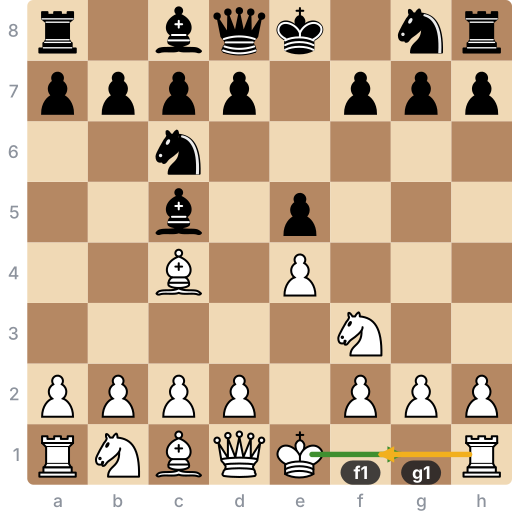
On its own, the king only ever moves one square at a time. Castling is the exception: once per game, your king may jump two squares towards one of your rooks, and that rook hops over to stand on the square the king just crossed. The two pieces move together, it counts as a single move, and the king always travels exactly two squares no matter which rook is involved. In the diagram, White's king goes from e1 to g1 and the h1 rook lands on f1. Black castles the same way on the other side of the board, e8 to g8. In freestyle chess, also called Chess960, the king and rook end on these same squares, but the king can start on another square, so it may move more or less than two squares.
The move exists for a simple reason: a king in the middle of the board stands on the most open files and diagonals, exactly where the heavy pieces will be aiming. Castling solves both problems at once — the king slides behind a wall of pawns in the corner, and the rook, the piece that most wants an open file, steps towards the centre.
The four conditions
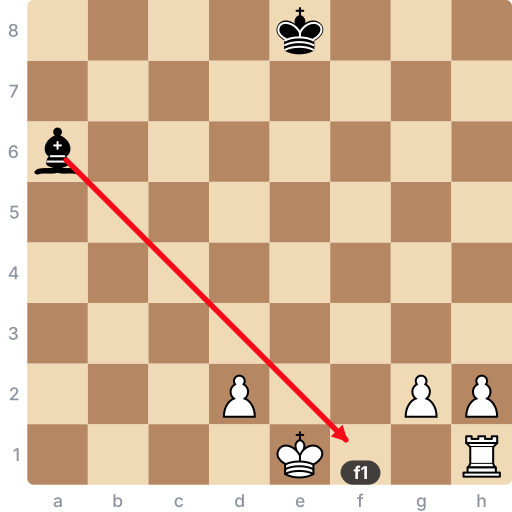
Castling is legal only when all four of these hold at the moment you want to play it:
- 1.Your king has not moved at any point in the game.
- 2.The rook you're castling with has not moved either.
- 3.Every square between the king and that rook is empty.
- 4.Your king is not in check, does not pass through a square an enemy piece attacks, and does not land on one.
The first two are permanent: once the king moves, castling is gone for the rest of the game, even if the king walks straight back. Moving one rook only spends castling on that side. The last two are temporary — a check or an attacked crossing square only stops you castling right now, and the option returns once the problem is dealt with. One detail that surprises people: only the king's squares matter. The rook may be under attack, and may even cross an attacked square, and castling is still perfectly legal.
Kingside vs queenside
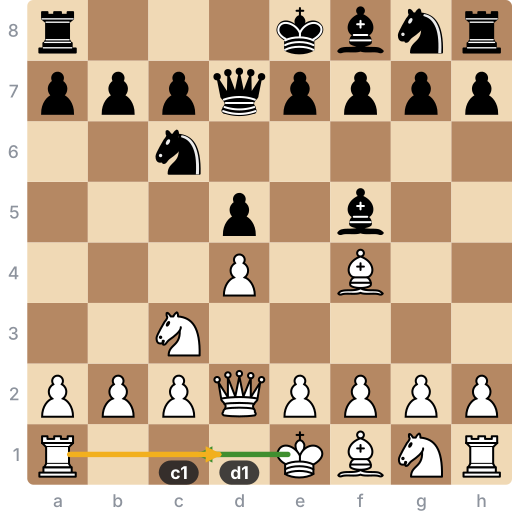
You may castle with either rook. Kingside (or "short") castling uses the rook nearer the king: the king lands on g1, the rook on f1, and only two squares need to be empty. Queenside (or "long") castling uses the far rook: the king lands on c1, the rook comes all the way around to d1, and three squares must be clear — b1, c1 and d1. That extra square is a real cost, since the queen and both queenside minor pieces have to move out of the way first, which is why kingside castling is the more common of the two by far.
The trade-off cuts both ways. Queenside castling takes longer to prepare, and the a-pawn starts unprotected by the king — but it plants the rook on the d-file, often the best file on the board, with no further effort. Games where the players castle on opposite sides tend to turn violent: each side can throw its pawns at the enemy king without exposing its own.
How it's written
Kingside castling is written O-O, queenside O-O-O — the only moves in chess recorded without a square name. Everything else on a scoresheet is covered in the chess notation guide.
When to castle
The beginner's rule is simply: early. Castling within the first ten moves, usually kingside, is sound advice in almost every game — an uncastled king in the centre is the raw material of most quick defeats. As you improve, the rule gains two refinements. First, look at the pawns in front of the castled king: if your opponent's pieces already aim at g2 and h2 (g7 and h7 for Black), or a pawn storm is coming on that side, castling there walks into the attack. Second, in queenless endgames the logic reverses — with no heavy pieces to fear, the king belongs in the centre, and castling can be a wasted move.
Castle yourself
The position below is from a normal Italian Game opening. Your king and h1 rook haven't moved, the squares between them are empty, and nothing attacks the king's path.
The squares between your king and the h1 rook are empty and neither piece has moved. Castle kingside.
Tap a piece, then tap where it should go.
Castling questions
Can you castle out of check?
No. If your king is in check, castling is not a legal answer to it. You must move the king, block the check, or capture the attacker — and you can still castle later, because being in check does not use up the right, only moving the king does.
Can you castle after moving your king?
No, and the right never comes back, even if the king returns to its starting square. Moving a rook works the same way, but only kills castling with that rook: the other side remains available.
Can you castle queenside?
Yes. You may castle with either rook. Queenside castling sends the king from e1 to c1 (e8 to c8 for Black) and the rook from a1 to d1. It needs three empty squares instead of two, so it usually takes one move longer to prepare.
How is castling written in notation?
O-O for kingside and O-O-O for queenside — the only moves in chess written without a square name. The zeros-or-letters question has a boring answer: officially they are capital letter Os.
Can you castle if your rook is under attack?
Yes. The restrictions are about the king only: it may not castle out of check, through an attacked square, or into one. The rook may be attacked, and may even pass through an attacked square on its way to d1.
Keep going: chess rules, en passant, the other special move and how to play chess for beginners.
This page in other languages: தமிழ் · हिन्दी · Hinglish · বাংলা · मराठी · Deutsch · Tiếng Việt · Polski · Bahasa Indonesia · Русский · ไทย · Italiano · Français · Türkçe · Español · Português · العربية
