


Chess rules
En Passant
The special pawn capture and its three conditions
En passant lets your pawn capture an enemy pawn that just used its two-square first move to rush past, as if it had only moved one square. Three conditions apply: the enemy pawn moved two squares, it landed beside your pawn on the same rank, and you capture on the very next move.
What en passant is
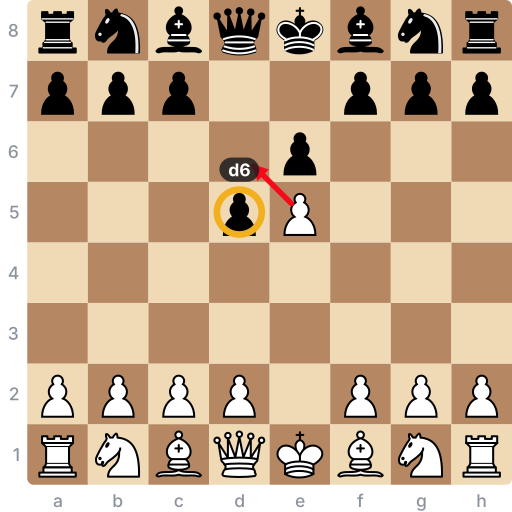
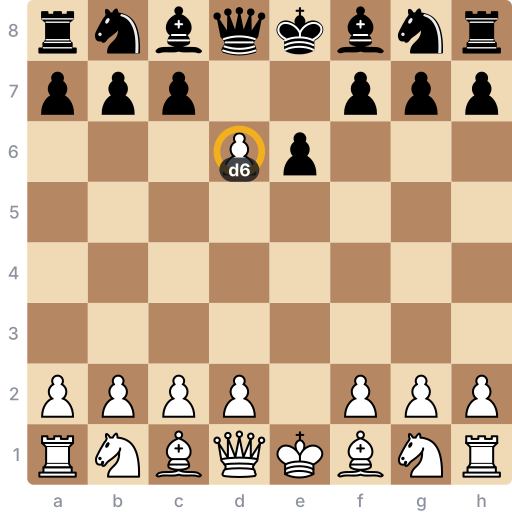
A pawn on its first move may advance two squares instead of one. En passant, French for "in passing", is the answer to a pawn that uses that sprint to dodge a capture. When an enemy pawn's two-square move lands it directly beside your pawn, on the same rank, you may capture it exactly as if it had moved only one square: your pawn goes diagonally to the square the enemy pawn skipped over, and the enemy pawn leaves the board. In the diagram, Black's pawn has just leapt from d7 to d5, right past White's pawn on e5. White may play the pawn to d6 and remove the d5 pawn: a capture on a square the captured pawn never occupied. It's the only capture in chess that works that way.
The three conditions
Every en passant capture requires all three of these, and nothing else:
- 1.The enemy pawn just moved two squares in a single move, which is only possible on its first move.
- 2.It landed directly beside your pawn, on the same rank. For White that's always the 5th rank; for Black, the 4th.
- 3.You capture immediately, on the very next move. Play anything else and the right is gone for the rest of the game.
The third condition is the one players miss: play any other move and the capture is gone for the rest of the game. And note what the rule involves: pawns only. A knight, bishop, rook or queen can neither capture nor be captured en passant.
How it's written
In notation, an en passant capture is written like any pawn capture, named by the square the capturing pawn lands on, not the square the victim stood on. The capture in the diagrams is exd6: the e-file pawn captures and arrives on d6. You'll sometimes see "e.p." added after the move, as in exd6 e.p., which is optional and just flags what happened. New to square names? The 30-second version is in the board setup guide.
Why the rule exists
En passant was added with the two-square first pawn move, around the fifteenth century, to stop a pawn from passing an enemy pawn without risk of capture. For centuries pawns could only ever move one square at a time. The two-square first move was introduced around the fifteenth century to speed up the opening, and it created a loophole: a pawn could now sprint straight past an enemy pawn that was waiting to capture it, something the old rules never allowed. En passant closed the loophole by preserving the old capture: the passing pawn can still be taken, exactly as if it had stepped one square.
Is en passant forced?
No, it's optional, like every capture in chess. You can decline it and play any other legal move; you simply lose the option afterwards. The internet's favorite version of this question comes from a long-running chess joke that declares en passant mandatory. It isn't, with one honest footnote: if en passant happens to be your only legal move, then you must play it, the same as any other move in that situation. It is rare: it needs a position where the king and every other piece are blocked and only the en passant capture is legal.
Play it yourself
Play the capture once on the board below: your pawn goes from e5 to d6 and the black pawn on d5 is removed. The position below is the one from the diagrams. Black's pawn has just landed on d5, and the en passant window is open.
Black's d-pawn just advanced two squares, straight past your pawn on e5. Capture it en passant.
Tap a piece, then tap where it should go.
En passant questions
Is en passant forced?
No, en passant is optional, like any other capture. The one exception is the same as for any move: if it happens to be your only legal move, you have to play it.
Can you capture a knight or a bishop en passant?
No. En passant only ever happens between pawns: a pawn captures an enemy pawn that just made its two-square first move. No other piece can capture, or be captured, this way.
Do you have to capture en passant immediately?
Yes. The right exists only on the move directly after the enemy pawn's two-square advance. Play anything else and the chance is gone for the rest of the game.
What does en passant mean?
It's French for "in passing", pronounced roughly "ahn pah-SAHN". The enemy pawn tried to pass yours with its double move, and you capture it in passing, as if it had moved only one square.
Why does en passant exist?
It closes a loophole. When the two-square first move was added in the fifteenth century to speed games up, it let pawns sprint past enemy pawns that would have captured them after a one-square step. En passant restored that capture, keeping the old pawn structure logic intact.
Keep going: chess rules and how to play chess for beginners.
This page in other languages: தமிழ் · हिन्दी · Hinglish · বাংলা · मराठी · Deutsch · Tiếng Việt · Polski · Bahasa Indonesia · Русский · ไทย · Italiano · Français · Türkçe · Español · Português · العربية
