


Chess rules
Chess Piece Values
What every piece is worth
Pawn 1, knight 3, bishop 3, rook 5, queen 9. Five numbers that answer the question behind almost every capture in chess: is this trade good for me? Here's where they come from, how to use them, and the situations where they stop telling the truth.
The values
| Piece | Worth | Moves |
|---|---|---|
| King | The game | One square in any direction |
| Queen | 9 points | Any distance in all eight directions |
| Rook | 5 points | Any distance in straight lines |
| Bishop | 3 points | Any distance along diagonals |
| Knight | 3 points | An L-shape: two squares, then one across; jumps over pieces |
| Pawn | 1 point | One square forward; two on its first move; never backwards |
The pawn is the unit: everything else is measured in pawns. The king carries no number because it can never be traded — losing it is losing the game, so its price is infinite. Knights and bishops together are called the minor pieces; rooks and the queen, the major or heavy pieces.
Where the numbers come from
The values are a shorthand for mobility and reach. A rook on an open board controls fourteen squares from anywhere; a bishop, at best, thirteen from the centre but only seven from a corner, and only ever squares of one color. A knight's eight squares shrink to two in a corner. The queen combines rook and bishop, and her 9 (rather than 5 + 3) reflects the power of doing both at once. The same logic explains the pawn's 1: it's the slowest piece on the board — but never let the number make you careless, because a pawn that reaches the last rank promotes to a queen, and the threat of that turns endgames.
Using the values in trades
The arithmetic of a capture is simple: compare what you give with what you get. Equal numbers make an even trade; unequal numbers mean someone profited. A few trades come up so often they have names:
- 1.Winning the exchange: your knight or bishop (3) for their rook (5). About two pawns of profit.
- 2.The minor-piece trade: knight for bishop (3 for 3), even on paper — the position decides who's happier.
- 3.Two minor pieces (6) for a rook and pawn (6): even by the count, but the two pieces are usually stronger in the middlegame.
- 4.Queen (9) for two rooks (10): the rooks win the count, and usually the endgame — the queen wants targets, the rooks want teamwork.
The values also set the pecking order of threats. Attacking a queen with a knight is a real threat — she must move or be traded at a loss. A knight that is safely defended by a pawn can sometimes ignore a queen's attack: if the queen captures, the pawn recaptures, trading 9 points for 3. The position still decides whether the knight is safe or has to move.
When the numbers lie
The points are a guide to material. The count fails in three cases. First, activity outranks arithmetic: a rook stuck behind its own pawns is worth less than a bishop raking an open diagonal, whatever the table says. Second, the values drift with the position — bishops gain in open positions and often work best as a pair, knights gain in closed ones, and rooks grow as files open in the endgame. Third, checkmate outranks everything: a sacrifice that gives up a queen for mate isn't losing 9 points, it's winning the game. The count never decides the result — only checkmate does. A sacrifice is correct when the material given up returns as checkmate, a forced win of more material, or a promotion. The same accounting applies to gambits: the King's Gambit (1.e4 e5 2.f4) offers a pawn for faster development and open lines, and the Benko Gambit (1.d4 Nf6 2.c4 c5 3.d5 b5) offers one for long-term pressure on the queenside.
Pick the right capture
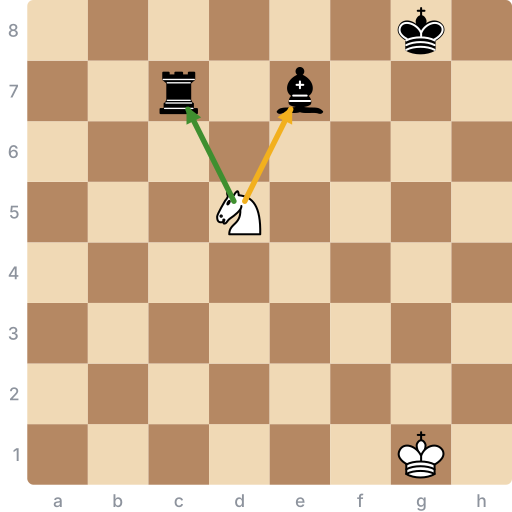
Your knight forks two pieces in the position below. One capture wins 5 points, the other 3.
Your knight attacks the rook on c7 and the bishop on e7. Capture the more valuable piece.
Tap a piece, then tap where it should go.
Piece value questions
How many points is each chess piece worth?
Pawn 1, knight 3, bishop 3, rook 5, queen 9. The king has no number because it can never be traded: losing it is losing the game.
Is a bishop worth more than a knight?
They both count as 3, and which one is really better depends on the position: bishops prefer open positions with long diagonals, knights prefer closed ones with fixed pawns. Two bishops together are usually worth a little extra — many players count the pair as roughly half a pawn.
How many points is the king worth?
None — or all of them. The king is never counted because it cannot be captured or traded; checkmating it is the goal of the game. As a fighting piece in the endgame it moves like a slower queen and is often reckoned to be worth about 4 points of activity.
What is the exchange in chess?
Trading a rook for a bishop or knight. The side giving up the rook has "lost the exchange" — about 2 points by the standard count. Deliberately doing so for other benefits is an exchange sacrifice.
Do the points decide who wins?
No. The points are a guide for trades, not a score: nobody adds them up at the end, and the game is won by checkmate alone. A side down a full queen wins the moment the enemy king is mated.
Keep going: chess rules, chess notation, how moves are written, chess strategies for beginners and how to play chess for beginners.
This page in other languages: தமிழ் · हिन्दी · Hinglish · বাংলা · मराठी · Deutsch · Tiếng Việt · Polski · Bahasa Indonesia · Русский · ไทย · Italiano · Français · Türkçe · Español · Português · العربية
