


Chess rules
Chess Notation
How to read and write chess moves
Algebraic notation writes any chess move in two to five characters: which piece, and where it went. It's how games are recorded, how books and puzzles talk to you, and how players study games played two hundred years ago. The full system is below: square names, piece letters, captures, checks, castling and promotion, with a game to read move by move.
How squares are named
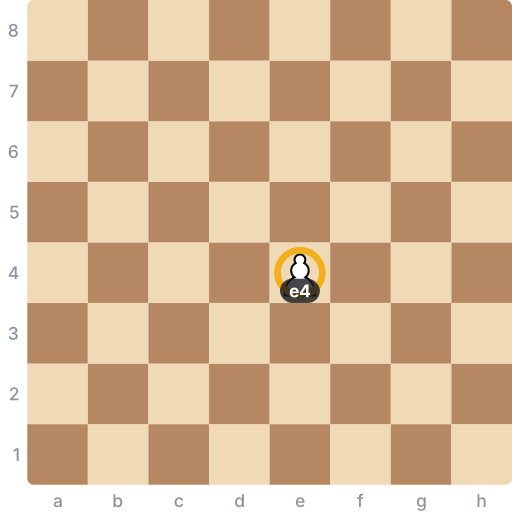
Every square has a name made of a letter and a number. The columns, called files, are lettered a to h starting from White's left. The rows, called ranks, are numbered 1 to 8 starting from White's side. So White's king starts on e1, Black's on e8, and the square in the diagram is e4: file e, rank 4. The names never change with your point of view — e4 is e4 whichever side of the board you sit on, which is what lets two players and a scoresheet agree about anything.
The piece letters
Each piece gets one capital letter: K for the king, Q for the queen, R for the rook, B for the bishop, and N for the knight, which lost the letter K to the king and uses its second letter instead. The pawn gets no letter at all: a move written as a bare square, like e4, is always a pawn move.
Reading a move
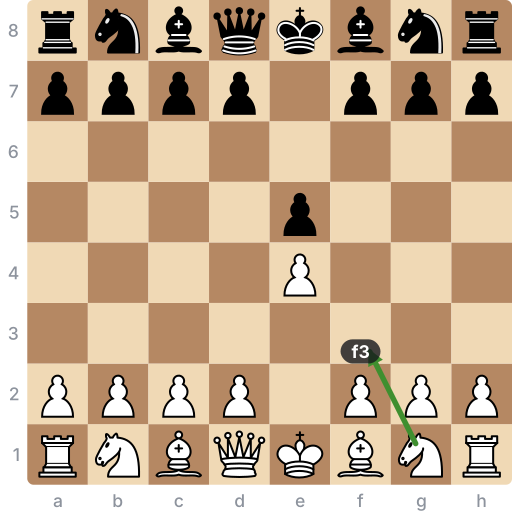
A move is the piece letter followed by the destination square. Nf3 means a knight moves to f3. Be2 means a bishop moves to e2. e4 means a pawn moves to e4. Notice what's missing: the starting square. Notation only tells you where the piece landed, and you're expected to see which piece could get there — almost always exactly one can.
When two identical pieces could reach the same square, one extra character breaks the tie: the file of the piece that moved, or the rank if the file matches too. With rooks on a1 and f1 both able to reach d1, the moves are Rad1 and Rfd1. In a written game, moves come in numbered pairs, White's move first: 1. e4 e5 2. Nf3 Nc6 means White pushed the e-pawn, Black mirrored, White developed the knight, and Black answered in kind. Openings are named by their first moves, so a scoresheet also tells you which opening was played: 1. e4 e5 2. Nf3 Nc6 3. Bb5 is the Ruy Lopez, and 1. d4 d5 2. c4 is the Queen's Gambit.
Captures, checks, castling and promotion
| Symbol | Meaning | Example |
|---|---|---|
| x | A capture | Bxe5 — bishop takes on e5 |
| + | Check | Qh5+ — queen to h5, attacking the king |
| # | Checkmate | Qh7# — queen to h7, game over |
| O-O | Kingside castling | King to g1, rook to f1 |
| O-O-O | Queenside castling | King to c1, rook to d1 |
| = | Promotion | e8=Q — the pawn becomes a queen |
| e.p. | En passant (optional) | exd6 e.p. — the special pawn capture |
Two rows need one more detail. Pawn captures use the pawn's starting file in place of a piece letter: exd5 means the e-pawn captured on d5. And castling is the only move written with no square at all — it has its own page covering the full rules. You'll also meet the commentary marks: ! for a good move, ? for a mistake, !! and ?? for the spectacular versions of each. They're opinions, not moves — a scoresheet never needs them.
A full game, annotated
Here is the shortest famous game in chess, the Scholar's Mate pattern, written out in full: 1. e4 e5 2. Bc4 Nc6 3. Qh5 Nf6?? 4. Qxf7#. Read it move by move: pawn to e4, pawn to e5; bishop to c4, knight to c6; queen to h5, knight to f6 (a blunder — hence ??); queen takes on f7, checkmate. Qxf7# reads as: Q the queen, x a capture, f7 the square, # checkmate. Why that final move is mate, and the other patterns that end games, are in the checkmate guide.
Read one yourself
The position below comes after 1. e4 e5. The scoresheet gives White's next move — read it and play it on the board.
The scoresheet says White's next move is Nf3. Read it, find it, play it.
Tap a piece, then tap where it should go.
Notation questions
What does x mean in chess notation?
A capture. Bxe5 means a bishop captures whatever stands on e5. For pawn captures the pawn's starting file stands in for a piece letter: exd5 means the e-pawn captures on d5.
What do + and # mean in chess?
+ means check: the move attacks the enemy king. # means checkmate: the king is attacked and has no escape, so the game is over. Qh5+ is a check; Qh7# ends the game.
What does O-O mean in chess?
Kingside castling: the king jumps two squares towards the h-rook and the rook lands beside it. O-O-O is the queenside version. They are the only moves written without a destination square.
Why is there no letter for the pawn?
Pawn moves are written with the destination square alone — e4 means a pawn moves to e4. Since every other piece gets a capital letter (K, Q, R, B, N), a move that starts with a small letter can only be a pawn move, so a symbol would add nothing.
Why is N used for the knight?
K was already taken by the king, so the knight uses its second letter. In older English books you'll see Kt instead; modern algebraic notation settled on N.
Keep going: chess rules, chess board setup, where the files and ranks come from and chess piece values, what each piece is worth.
This page in other languages: தமிழ் · हिन्दी · Hinglish · বাংলা · मराठी · Deutsch · Tiếng Việt · Polski · Bahasa Indonesia · Русский · ไทย · Italiano · Français · Türkçe · Español · Português · العربية
