White points a bishop at the one knight holding up their middle pawn, and the pressure never lets go. You play the setup, all three answers to the pokes, and a full game against an opponent that hunts your bishop.
Start here
0
Chapter 1: The Setup
Main line: 1.e4 e5 2.Nf3 Nc6 3.Bb5
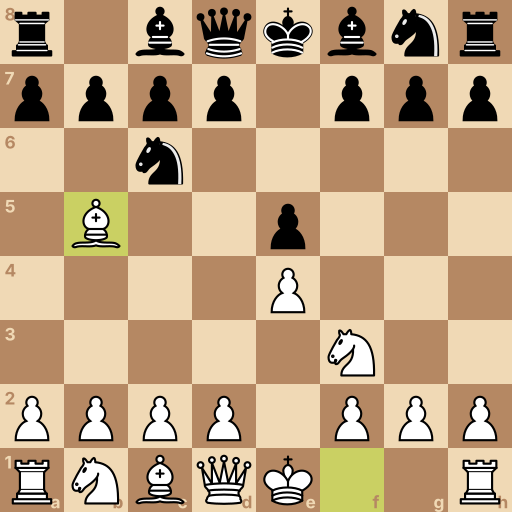
Position after 1.e4 e5 2.Nf3 Nc6 3.Bb5. Black to move.
Every opening starts as a fight over these four middle squares. A piece in the middle reaches the whole board; a piece stuck at home reaches almost nothing.
White moves first, so you take one of the four right away.
Your move: Push the pawn in front of your king two squares, to e4, and take your first middle square.
1.e4 Try the pawn in front of your king — two steps to e4 grabs the middle.
Your move: They answer with e5 and the pawns block each other. Bring your king's knight to f3, where it attacks their middle pawn.
2.Nf3 Hop the knight to f3 — it develops and attacks e5 in one go.
Your move: Their knight steps up to guard e5. Now the Spanish move — bishop to b5, attacking the guard itself.
3.Bb5 Slide the bishop to b5 — it leans on the knight that guards e5.
Question: Your bishop attacks their knight. What is the real target?
Answer: The e5 pawn — that knight is its only guard. Follow the chain — the bishop leans on the knight, and the knight holds up e5. Take the knight at the right moment and e5 falls with it. That chain — bishop on knight, knight on pawn — is the whole Spanish idea.
That is the Ruy Lopez: e4, Nf3, and the bishop to b5. Three moves, and every one of them leans on e5.
Nearly everyone pokes your bishop with a6. Some bring the knight to f6 instead, and some prop the pawn with d6. You will learn all three.
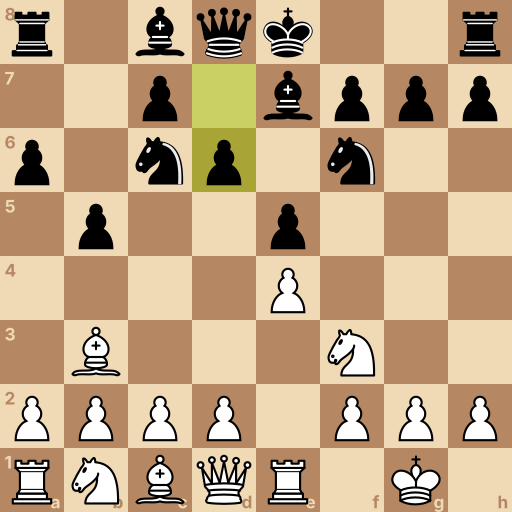
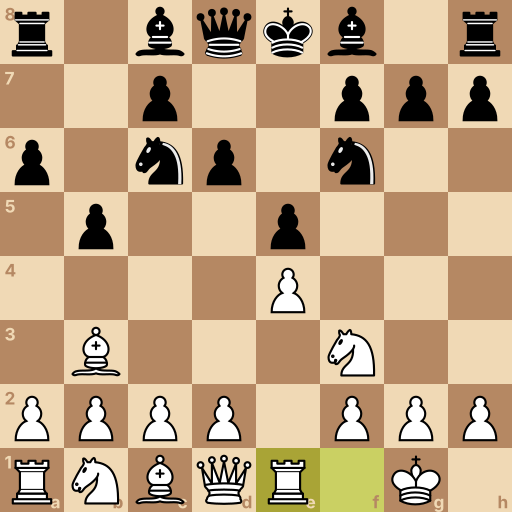
Position after 1.e4 e5 2.Nf3 Nc6 3.Bb5 a6 4.Ba4 Nf6 5.O-O Be7 6.Re1 b5 7.Bb3 d6. White to move.
The little a-pawn asks your bishop a question: trade or run? Trading gives away your best piece for a knight and lets them fix their pawns.
So you dodge — same diagonal, same lean on the knight, just out of the pawn's reach.
Your move: Slide your bishop back to a4 — out of reach, still staring at their knight.
4.Ba4 Keep the bishop — back to a4, same diagonal, same lean.
Your move: Their knight comes to f6 and eyes your e4 pawn. Castle anyway — if they ever grab e4, your rook slides to e1 and wins the pawn back with interest.
5.O-O Castle — slide your king two squares right. The e4 pawn is bait, not a blunder.
Your move: They develop the bishop to e7. Bring your rook to e1, guarding e4 before it ever needs guarding.
6.Re1 Rook to e1 — it stands behind e4 and ends every trick against it.
Your move: The b-pawn pokes your bishop again. Dodge again — to b3, and now it lands on the diagonal that points straight at f7.
7.Bb3 Slide to b3 — every poke has pushed your bishop onto a better square.
Question: So what is the Spanish plan?
Answer: Keep the lean on e5 and build c3 then d4. The bishop dodged twice to keep leaning — now the middle push comes. The pressure never went away; a6 and b5 only moved it around. c3 and d4 come next, and the middle opens while e5 is still pinned down.
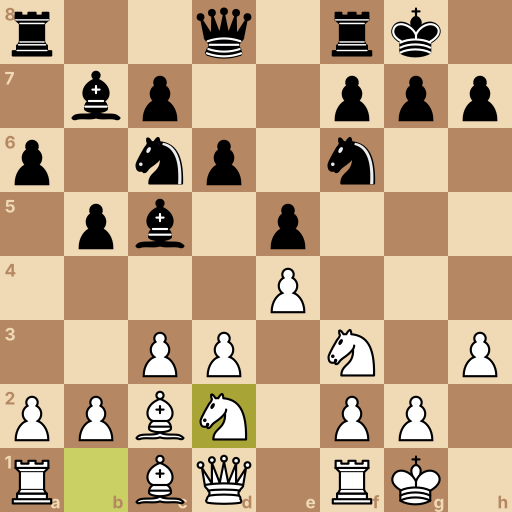
Position after 1.e4 e5 2.Nf3 Nc6 3.Bb5 Nf6 4.d3 Bc5 5.c3 O-O 6.O-O d6 7.h3 a6 8.Ba4 b5 9.Bc2 Bb7 10.Nbd2. Black to move.
No poke this time — the knight comes out and stares at e4. This is the Berlin, solid as stone.
One quiet pawn step holds everything: d3 guards e4 and keeps every piece flexible. This chapter is the full Spanish house, ending with your king castled.
Your move: Push your d-pawn one square to d3 and guard the e4 pawn.
4.d3 One small step — d3 props up e4.
Your move: Their bishop lands on c5. Push your c-pawn to c3 — it takes squares from their pieces and prepares your own d4 push.
5.c3 Quiet but useful — c3 takes b4 and d4 away and preps the middle push.
Your move: They castle, and your king goes next. Castle by moving your king two squares right.
6.O-O Time to castle — slide your king two squares to the right.
Your move: They prop up e5 with d6. Push your h-pawn to h3 so their bishop can never pin your f3 knight.
7.h3 Little h3 shuts the g4 square — no pin on your knight, ever.
Your move: Now the poke comes late — a6 hits your bishop. Slide it back to a4, keeping the lean.
8.Ba4 Same answer as always — back to a4, same diagonal.
Your move: The b-pawn chases again. This time tuck the bishop to c2 — quiet, safe, and secretly aiming at h7.
9.Bc2 Tuck it to c2 — out of every pawn's reach, pointed at their king's corner.
Your move: Their bishop settles on b7. Bring your last knight to d2, starting the classic Spanish tour toward their king.
10.Nbd2 Knight to d2 — it will re-route through f1 and g3 toward their king.
Question: So how do you beat the Berlin wall?
Answer: You don't rush it — full setup, then the d4 push and the knight tour. Stone walls fall to patience — everything develops before anything opens. Your house is built and your king is safe. Two plans wait, ready whenever you choose: the d4 break in the middle, and the knight tour to g3 at their king.
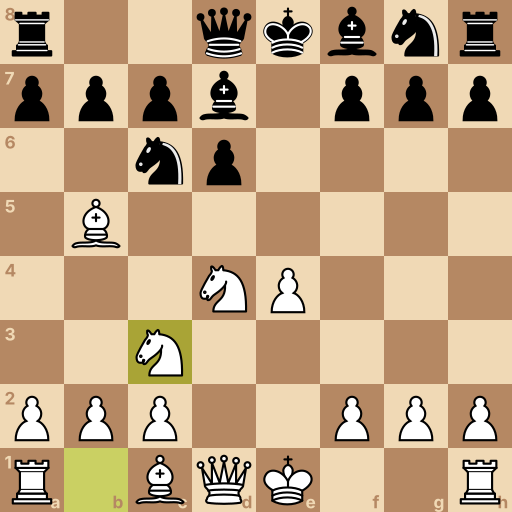
Position after 1.e4 e5 2.Nf3 Nc6 3.Bb5 d6 4.d4 exd4 5.Nxd4 Bd7 6.Nc3. Black to move.
d6 props up e5 with a pawn — solid, but it walls in their dark bishop and gives up the fight for d4.
When they turtle, you open the game. Your pieces breathe; theirs queue up behind pawns.
Your move: Strike the middle right now — push your d-pawn two squares to d4.
4.d4 They turtled — d4 cracks the middle open while they are cramped.
Your move: They trade pawns on d4. Take back with your knight, landing it in the middle.
5.Nxd4 Knight takes on d4 — it recaptures and centralizes in one move.
Your move: They tuck the bishop to d7, untangling. Bring your other knight to c3 — four of your pieces out, one of theirs.
6.Nc3 Knight to c3 — keep developing while they untangle.
Question: So how do you punish the quiet d6?
Answer: Open the middle while they are cramped. They built a low wall — so you open the game while your pieces breathe and theirs don't. The middle is open, four of your pieces are working, and their bishop still stares at its own pawns. Every open file and every trade favors the side with room.
Final challenge: The Bishop Hunter (800 Elo)
The opponent says: That bishop annoys me. I'll chase it off the board.
Your tasks in the game, in order:
Their a-pawn pokes your bishop. Slide it to a4 and keep the lean.
Castle — tuck your king away and free the rook.
The b-pawn pokes again. Dodge to b3, onto the diagonal that points at f7.
Bring your rook to e1, behind the e4 pawn.
Position after 1.e4 e5 2.Nf3 Nc6 3.Bb5 a6 4.Ba4 Nf6 5.O-O b5 6.Bb3 d6 7.Re1. Black to move.
History of the Ruy Lopez
The Ruy Lopez begins 1.e4 e5 2.Nf3 Nc6 3.Bb5 and occupies ECO codes C60 through C99. It is named after the Spanish priest Ruy López de Segura, who analyzed the opening in his 1561 chess treatise. It became a central part of master open-game practice during the nineteenth century.
Main ideas for White
White attacks e5 with the f3 knight and places the bishop on b5 against the c6 knight that supports that pawn. After a6 and b5, the bishop often retreats through a4 to b3 or c2 while preserving useful diagonals. White usually castles, places a rook on e1, builds with c3, and prepares d4. Black seeks time against the bishop, pressure on e4, and a stable e5 center.
Typical plans
Closed Spanish structures usually keep White pawns on e4 and c3 against Black pawns on e5, d6, and often b5. White prepares d4, reroutes the queenside knight through d2 and f1 toward g3, and may play a4 to challenge Black's queenside chain. Black seeks queenside space and central counterplay with c5 or d5, while White usually develops kingside activity and pressure along the e-file.
Common mistakes
Do not exchange on c6 automatically after a6; retreat to a4 when preserving the bishop maintains more pressure on e5.
Do not leave e4 unsupported after Black develops Nf6; use d3 or Re1 while completing development and preparing the center.
Do not rush d4 before c3 in closed structures; build enough support so the central break does not lose a pawn.
Related openings
Italian Game1.e4 e5 2.Nf3 Nc6 3.Bc4. Fast pieces, and a bishop aimed straight at f7.
Vienna Game1.e4 e5 2.Nc3. Knight out first, f-pawn free to charge.
King's Gambit1.e4 e5 2.f4. Spend a pawn, own the middle and an open file.
Scotch Game1.e4 e5 2.Nf3 Nc6 3.d4. Break the middle open on move three.
Caro-Kann Defense1.e4 c6. Answer 1.e4 with a middle pawn that arrives guarded.
French Defense1.e4 e6. One pawn guards, the next one strikes the middle.