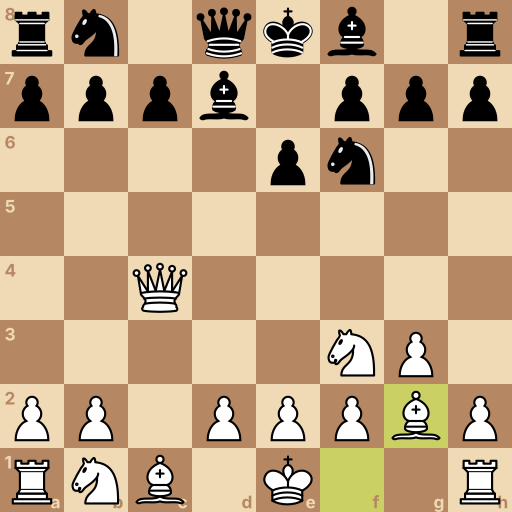
You start with a knight instead of a pawn, attack their middle from the side, and press it from both corners with fianchettoed bishops. You play the setup, both replies, and a full game against an opponent that snatches your c-pawn.
Start here
0
Chapter 1: The Knight First
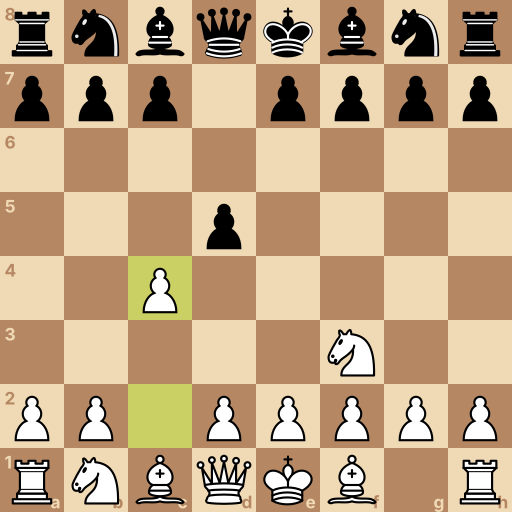
Main line: 1.Nf3 d5 2.c4
Position after 1.Nf3 d5 2.c4. Black to move.
These four squares are the middle of the board. A piece standing near them reaches everywhere; a piece stuck on the edge reaches half as far.
White moves first. This opening's first move fights for the middle without placing a single target in it.
Your move: Jump your kingside knight to f3. It watches e5 and d4 — two middle squares claimed, and nothing of yours can be attacked.
1.Nf3 The knight beside your king's rook — one jump to f3 watches two middle squares.
Your move: They take the middle with d5. Answer from the side: push c4 and attack that pawn without ever giving them a target.
2.c4 The c-pawn, two steps — it attacks d5 from the flank.
Question: Two moves in, you have no pawn in the middle. What do you have instead?
Answer: Pressure on their middle, and not one target they can attack. Find a white pawn or piece their army can usefully go after. Their middle pawn is attacked and has decisions to make; your position offers nothing to hit back at. Pressure without targets is the Réti's whole personality.
This is the Réti Opening. The knight came first, the flank pawn asks the questions.
They can grab your c-pawn or hold their ground. The next chapters answer both.
Chapter 2: The Grab
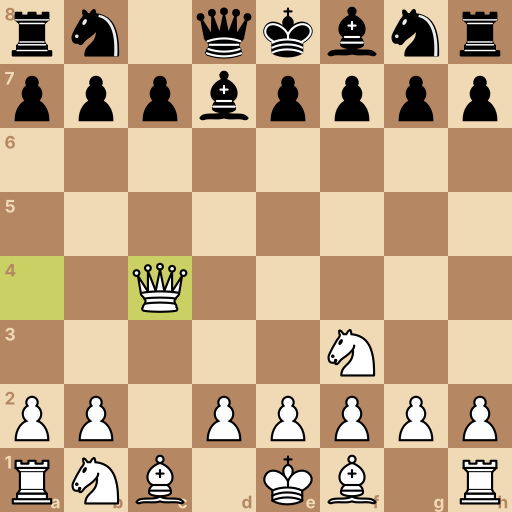
Main line: 1.Nf3 d5 2.c4 dxc4 3.Qa4+ Bd7 4.Qxc4
Position after 1.Nf3 d5 2.c4 dxc4 3.Qa4+ Bd7 4.Qxc4. Black to move.
They grab the c-pawn — and their only middle pawn leaves the middle to do it.
The pawn never sticks. Your queen collects it with a check on the way.
Your move: Swing your queen to a4, with check. The king question comes first — so the c4 pawn gets no help.
3.Qa4+ The queen slides to a4 — check first, pawn second.
Your move: They block with the bishop. Collect the pawn — queen takes on c4, material even again.
4.Qxc4 The queen collects the c4 pawn — the grab lasted two moves.
Question: Material is even again. Who came out of the exchange better?
Answer: You — their middle pawn is gone and the middle is yours to claim. Compare the middle now to two moves ago — and check what can chase your queen. They traded their only middle pawn for a flank pawn that came straight back. The queen sits safe on c4 — their d7 bishop blocked its own pieces, so no quick chase is coming. You develop; they regret.
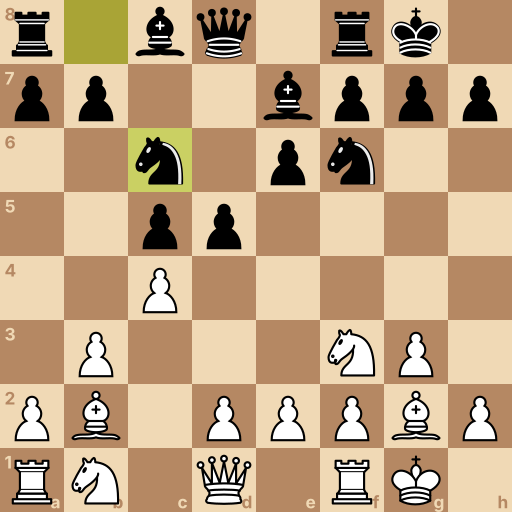
Position after 1.Nf3 d5 2.c4 e6 3.g3 Nf6 4.Bg2 Be7 5.O-O O-O 6.b3 c5 7.Bb2 Nc6. White to move.
When they guard their middle instead, you unveil the Réti's signature: a bishop in each corner, both pressing the middle from a distance.
This chapter builds the double fianchetto — the setup this opening is famous for.
Your move: One step with your g-pawn opens the first corner.
3.g3 One step with the g-pawn — the kingside corner opens for the bishop.
Your move: They develop their knight. Bishop to g2 — the first corner is manned, pressing at d5.
4.Bg2 The king's bishop tucks into g2, onto the long diagonal.
Your move: They tuck their bishop in. Castle — two squares toward the corner, king safe early.
5.O-O Two squares toward the corner — the rook jumps over by itself.
Your move: They castle too. One step with the b-pawn opens the second corner.
6.b3 One step with the b-pawn — the queenside corner opens for the other bishop.
Your move: They claim space with c5. Bishop to b2 — the second corner is manned, and both bishops now press the middle from a distance.
7.Bb2 The dark bishop tucks into b2 — both corners now watch the middle.
Question: Both bishops are in corners and their pawns fill the middle. Who stands better, and why?
Answer: You — their middle pawns are pinned down as targets while your position has none. Occupying and owning are different — ask who can attack whose middle. Their pawns stand in the middle; your pieces aim at it. Break with cxd5 or e4 or d4 when it suits you, and every trade opens a diagonal you already own. The Réti wins the middle late, on its own terms.
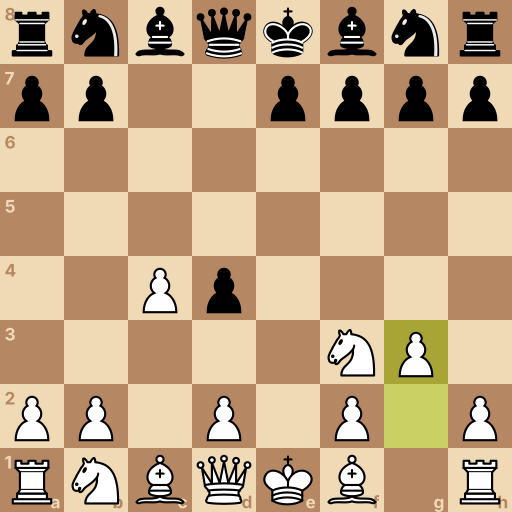
Position after 1.Nf3 d5 2.c4 d4 3.e3 c5 4.exd4 cxd4 5.g3. Black to move.
The third answer: they push past your c-pawn and plant their pawn deep on d4.
A pawn that deep is cut off from home. Start undermining it at once.
Your move: One step with your e-pawn, to e3 — it attacks the advanced pawn immediately.
3.e3 One step with the e-pawn — it attacks the pawn that pushed past.
Your move: They prop it with c5. Take on d4 — make them commit another pawn to the deep square.
4.exd4 Your e-pawn takes on d4 — every recapture drags another pawn forward.
Your move: They take back, and one lone pawn stands deep in your half. Open your bishop's diagonal with g3 — the pawn's neighborhood is about to get hostile.
5.g3 One step with the g-pawn — the bishop comes next, and the d4 pawn has no friends.
Question: Their pawn sits on d4, alone in your half. How do you play against it?
Answer: Develop around it, blockade it, and collect it when it runs out of guards. A pawn that far from home can't feed itself — think siege, not snatch. Bishop to g2, knight maneuvers, rook to d1 — every developing move you make also happens to surround d4. A deep pawn with no support is not a spearhead; it is a long-term prisoner.
Final challenge: The Snatcher (800 Elo)
The opponent says: Loose pawn on c4? Snatched. What are you going to do about it?
Your tasks in the game, in order:
Queen to a4, with check — the king comes before the pawn.
They block — collect the c4 pawn with your queen.
Open the corner — one step to g3.
Bishop to g2, onto the long diagonal.
Position after 1.Nf3 d5 2.c4 dxc4 3.Qa4+ Bd7 4.Qxc4 Nf6 5.g3 e6 6.Bg2. Black to move.
History of the Réti Opening
The Réti Opening is commonly defined by 1.Nf3 d5 2.c4 and falls under ECO A09. It is named after Richard Réti, whose games and writings helped establish hypermodern opening play during the 1920s. The system invites a central pawn occupation and then attacks it from the flanks.
Main ideas for White
White begins with 1.Nf3 to control e5 and d4 without placing a pawn in the center, then uses 2.c4 to challenge d5. A bishop on g2 pressures the long diagonal toward b7, and a second fianchetto on b2 can add pressure against e5 and d4. Black usually supports the center with pawns on d5, e6, and c5, captures on c4, or advances the d-pawn to d4. White waits for the right central break instead of fixing the structure early.
Typical plans
After 1.Nf3 d5 2.c4 dxc4, 3.Qa4+ can recover the pawn after the check is answered. If Black maintains the center, White often castles, fianchettoes both bishops, and breaks with a capture on d5 or a pawn advance from e2 or d2. An advance to d4 can become an isolated target after the e-pawn challenges it; White then blockades the pawn and places a rook on the d-file. Black seeks space and may use the central pawns to restrict the bishops.
Common mistakes
Trying to win the c4 pawn immediately with the queen can waste time; use 3.Qa4+ so Black must answer the check first.
Fianchettoing both bishops without challenging the center gives Black free space; prepare a timely pawn break or exchange on d5.
Attacking an advanced d4 pawn before completing development can release its pressure; blockade it, improve the pieces, and collect it later.
Related openings
English Opening1.c4 e5 2.Nc3. Grip the middle from the side and squeeze.
King's Indian Attack1.Nf3 d5 2.g3. The same house every game, then the e5 wedge.
Bird's Opening1.f4. Claim e5 from the wing and attack the king.