You throw your b-pawn up the board on move one, trade it for a middle pawn, and play the rest of the game with the better share. You play the surprise, both replies, and a full game against an opponent that laughs at your first move.
Start here
0
Chapter 1: The Surprise
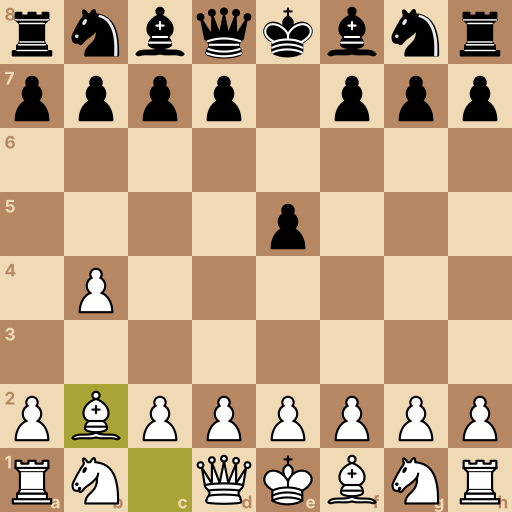
Main line: 1.b4 e5 2.Bb2
Position after 1.b4 e5 2.Bb2. Black to move.
These four squares are the middle of the board. A piece standing near them reaches everywhere; a piece stuck on the edge reaches half as far.
White moves first — and this first move looks like it forgot where the middle is. It hasn't. It is setting up a trade it wants.
Your move: Push your b-pawn two squares, to b4. It grabs queenside ground and opens the corner for your bishop — the piece this opening is really about.
1.b4 The b-pawn, two steps — ground on the wing, and the bishop's corner opens.
Your move: They take the middle with e5. Bishop to b2 — it attacks that pawn from the corner, and quietly offers your b4 pawn in return.
2.Bb2 The bishop lands on b2 and bites the e5 pawn straight away.
Question: Their bishop can just take your b4 pawn. Should that worry you?
Answer: No — you'll take e5 back: their middle pawn for your wing pawn is a trade you want. Compare what each pawn was doing for its owner. If they take b4, your bishop takes e5 — a wing pawn for a middle pawn. You end up with two middle pawns to their one, and the better long-term structure. The Polish looks like a joke and trades like a banker.
This is the Polish Opening. The offer is on the table and it favors you either way.
The next chapter plays out the main trade and counts the winnings.
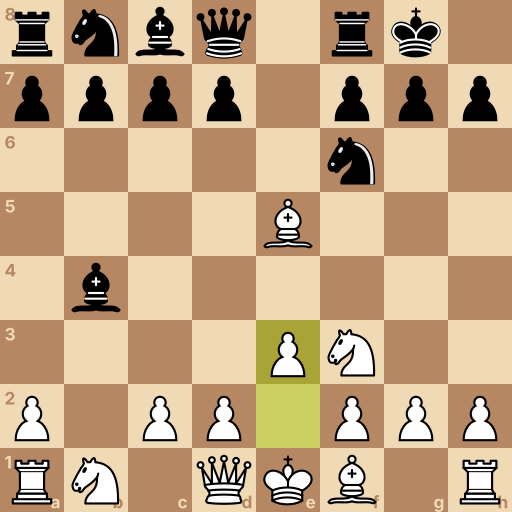
Position after 1.b4 e5 2.Bb2 Bxb4 3.Bxe5 Nf6 4.Nf3 O-O 5.e3. Black to move.
They take the wing pawn with the bishop. Complete the deal: your bishop collects their middle pawn.
Watch the pawn count in the middle files when the dust settles.
Your move: Take the e5 pawn with your bishop.
3.Bxe5 The bishop collects the middle pawn — the trade completes in your favor.
Your move: Their knight comes out and eyes your bishop. Develop with a guard: knight to f3.
4.Nf3 The knight develops and stands by the bishop.
Your move: They castle. One step with your e-pawn — the second bishop gets its door, and your structure settles.
5.e3 One step with the e-pawn — the light bishop's door opens.
Question: Count the middle-file pawns: you have d and e, they have d only. What is that worth?
Answer: A middle majority — later your two pawns advance where their one can't answer. Two against one on the files that matter — picture them advancing together. When your d- and e-pawns roll forward side by side, their single d-pawn can't hold the line. That majority is the banked profit of move one, and the middlegame is where you spend it.
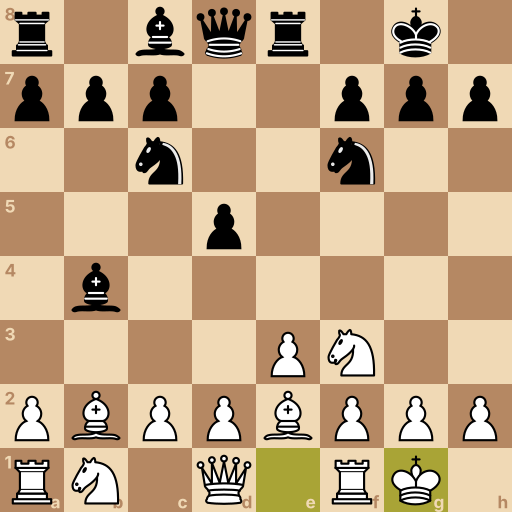
Position after 1.b4 e5 2.Bb2 Bxb4 3.Bxe5 Nf6 4.Nf3 O-O 5.e3 d5 6.Be2 Re8 7.Bb2 Nc6 8.O-O. Black to move.
They stake their claim with d5. Finish developing — and bring the traveling bishop home before their rook starts asking it questions.
Profit is only profit once it is safe.
Your move: Bishop to e2 — modest, solid, clearing your castle.
6.Be2 The light bishop steps to e2 and clears the runway.
Your move: Their rook slides toward your advanced bishop. Bring it home to b2 — back to the long diagonal where it started, profits banked.
7.Bb2 The bishop retreats to b2 with a pawn's worth of profit behind it.
Your move: They develop. Castle — two squares toward the corner.
8.O-O Two squares toward the corner — the rook jumps over by itself.
Question: Development done, majority banked, bishop home. What wins from here?
Answer: Patience — c4 pokes their middle, then the d- and e-pawns advance together. Your winnings are structural — structures cash out slowly. Poke with c4, trade at your convenience, and start the two middle pawns walking. Every simplification makes the majority louder. The surprise got you the goods; patience delivers them.
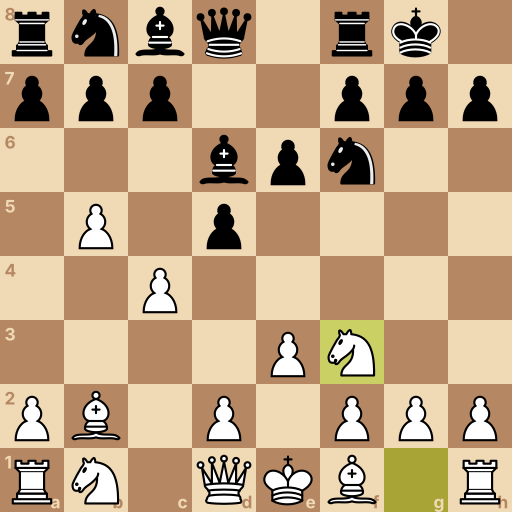
Position after 1.b4 d5 2.Bb2 Nf6 3.e3 e6 4.b5 Bd6 5.c4 O-O 6.Nf3. Black to move.
The other answer: they ignore your wing entirely and just take the middle.
Then the b-pawn plays its second role — not a trade offer, but the front runner of a land grab.
Your move: Bishop to b2 — same corner, same long diagonal, now staring at their kingside.
2.Bb2 The bishop takes its corner and eyes the long diagonal.
Your move: They develop. One step with your e-pawn — quiet support before the expansion.
3.e3 One step with the e-pawn — the house settles before the push.
Your move: They build their wall. March: push b5 and annex another rank of queenside ground.
4.b5 The b-pawn advances to b5 — the queenside annex grows.
Your move: They develop the bishop. Add the neighbor: push c4 and pry at their middle from your annexed ground.
5.c4 The c-pawn, two steps — the annex leans on their middle.
Question: You own the queenside and lean on their middle. Where is this game decided?
Answer: On the queenside files — open the c-file, land the rooks, and squeeze. Your space, your files, your rooks — follow the ground you annexed. Trade on d5 when it suits you, put rooks on the b- and c-files, and their queenside suffocates one square at a time. They laughed at move one; the c-file gets the last word.
Final challenge: The Mocker (800 Elo)
The opponent says: 1.b4? Seriously? Is that even a real opening?
Your tasks in the game, in order:
Bishop to b2 — bite their middle pawn and offer yours.
They took the wing pawn — collect their middle pawn.
Develop with a guard — knight to f3.
One step to e3 — the second bishop's door.
Position after 1.b4 e5 2.Bb2 Bxb4 3.Bxe5 Nf6 4.Nf3 O-O 5.e3. Black to move.
History of the Polish Opening
The Polish Opening begins 1.b4 and is classified under ECO A00. Its Polish name reflects the opening's association with Polish master Savielly Tartakower, who used it in tournament play during the early twentieth century. It also became known as the Sokolsky Opening after Alexey Sokolsky studied and played it extensively during the middle of that century.
Main ideas for White
White uses 1.b4 to gain queenside space and clear b2 for the dark-squared bishop. After 1...e5 2.Bb2, the bishop attacks e5 along the long diagonal; if 2...Bxb4, 3.Bxe5 exchanges a wing pawn for a central pawn. Nf3 and e3 then develop safely and support the bishop before it returns to b2. Black usually occupies the center with e5 or d5 and tries to attack the advanced b-pawn before White consolidates.
Typical plans
After the exchange on e5, White often keeps pawns on d2 and e3 against Black's d5 pawn, giving White a central pawn majority. White completes development, castles, returns the dark-squared bishop to b2, and challenges d5 with c4 before advancing d4 and e4 when supported. If Black declines the b-pawn with 1...d5, White may gain more queenside space with b5 and c4. Black seeks central or kingside play, while White uses the b- and c-files.
Common mistakes
Do not push 1.b4 and neglect the b2 bishop; develop Bb2 promptly so the advanced pawn supports pressure on the center.
Do not treat 1...e5 2.Bb2 Bxb4 as a loss; answer with 3.Bxe5 and exchange a wing pawn for a central pawn.
Do not force a kingside attack from this structure; use c4 against d5 and place rooks on the b- and c-files.
Related openings
English Opening1.c4 e5 2.Nc3. Grip the middle from the side and squeeze.
Réti Opening1.Nf3 d5 2.c4. Press their middle without offering a target.
King's Indian Attack1.Nf3 d5 2.g3. The same house every game, then the e5 wedge.
Bird's Opening1.f4. Claim e5 from the wing and attack the king.