You start with the most flexible move in chess, invite them to build a giant middle, and then chew it apart with the bishop watching from the corner. You play the invitation, both replies, and a full game against an opponent that grabs all the land they can.
Start here
0
Chapter 1: The Invitation
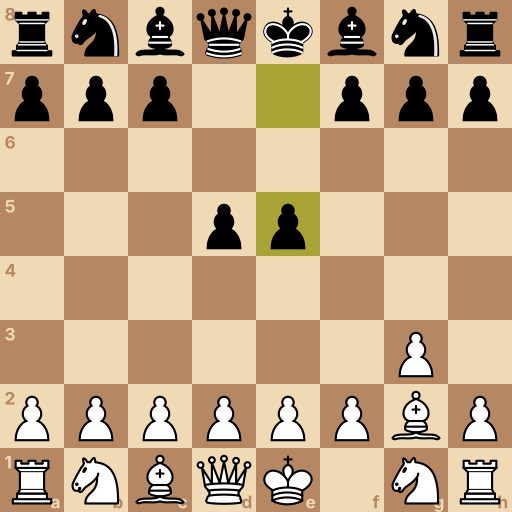
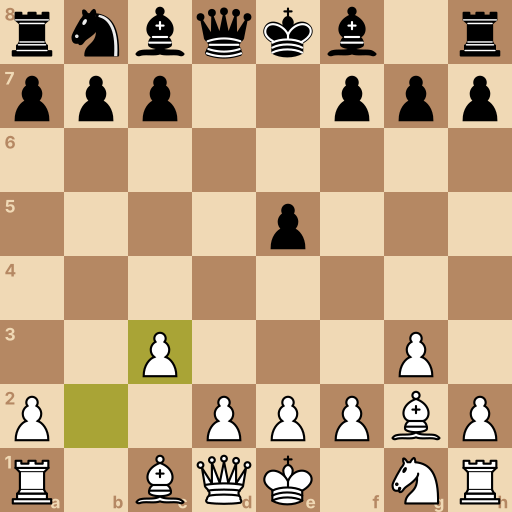
Main line: 1.g3 d5 2.Bg2 e5
Position after 1.g3 d5 2.Bg2 e5. White to move.
These four squares are the middle of the board. A piece standing near them reaches everywhere; a piece stuck on the edge reaches half as far.
White moves first — and this opening's first move commits to almost nothing, while preparing a bishop that watches everything.
Your move: One step with your g-pawn. That's the whole move — no target offered, no plan revealed, and the corner opens for your bishop.
1.g3 One step with the g-pawn — the most flexible first move there is.
They take the middle — and with your next quiet move, they will likely take more. Let them.
Every pawn they advance becomes a commitment. Your bishop is about to watch all of it from a square nothing can touch.
Your move: Bishop to g2 — the long diagonal, aimed straight through their new middle pawn.
2.Bg2 The bishop tucks into g2 and stares down the long diagonal.
Question: They will probably grab even more middle now — e5 next. Should that worry you?
Answer: No — a middle that big is a commitment, and your whole setup exists to chew on it. Big pawn middles need constant guarding — ask who is set up to attack this one. Two pawns abreast look mighty and defend nothing by themselves. Your c4 break, your knight, and the g2 bishop all bite at them from the sides. The invitation was sincere — and so is the bill that follows.
This is the King's Fianchetto Opening. The middle is theirs; the pressure on it is yours.
The next chapter starts the chewing — from the side, as always.
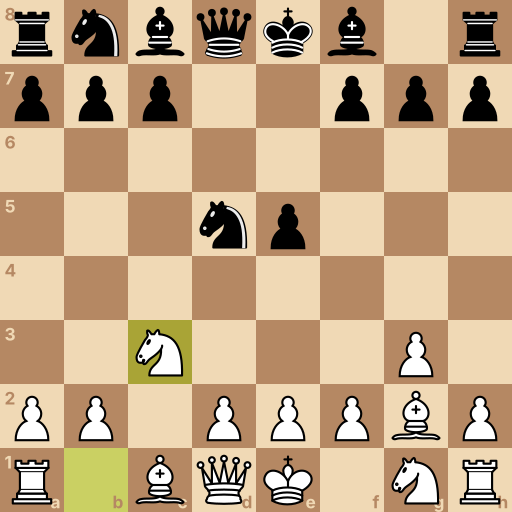
Position after 1.g3 d5 2.Bg2 e5 3.c4 Nf6 4.cxd5 Nxd5 5.Nc3. Black to move.
Their big middle stands tall. Start taking it apart at the base — the d5 pawn holds everything up.
Hit it from the side, trade it off, and watch the rest wobble.
Your move: Push c4 and attack the base of their middle.
3.c4 The c-pawn, two steps — it bites the pawn holding their middle up.
Your move: They develop and hold. Take on d5 — the base trades off, and whatever recaptures stands in your bishop's stare.
4.cxd5 Take the base — the recapture lands on a watched square.
Your move: Their knight takes back — straight into the g2 bishop's line. Add the second attacker: knight to c3.
5.Nc3 The knight joins — two attackers now lean on their d5 knight.
Question: Their knight on d5 is attacked twice. Whatever they do costs something — what is the pattern here called?
Answer: Pressure — their pieces answer your questions while your position stays untouched. You have made threats three moves running — count the threats they have made. Trade on c3 and your pawns improve; retreat and your bishop rules the diagonal; defend and another attacker comes. Meanwhile nothing in your camp needs guarding. One-way pressure is the fianchetto player's favorite weather.
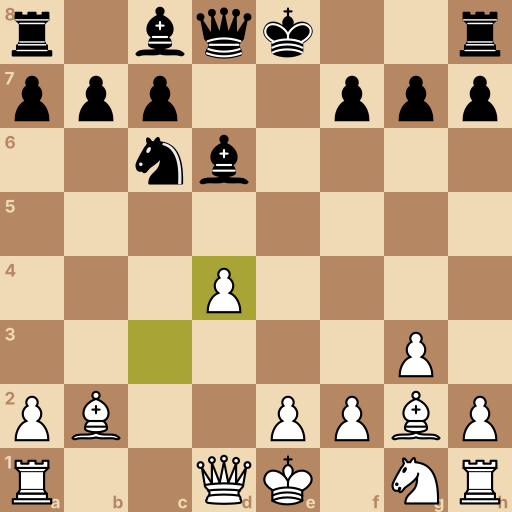
Position after 1.g3 d5 2.Bg2 e5 3.c4 Nf6 4.cxd5 Nxd5 5.Nc3 Nxc3 6.bxc3 Nc6 7.Bb2 Bd6 8.d4 exd4 9.cxd4. Black to move.
They trade the knight. Take back with the b-pawn — and notice your c1 bishop's new door, opened by that very capture.
Their remaining e5 pawn is next on the menu.
Your move: Take back with your b-pawn.
6.bxc3 The b-pawn takes back — and opens the second bishop's door.
Your move: They develop. Your dark bishop to b2 — now both bishops stare at their lone e5 pawn from the corners.
7.Bb2 The dark bishop joins from b2 — two corner bishops, one target.
Your move: They prop the pawn with the bishop. Push d4 — your c3 pawn backs it, and the last of their proud middle comes under fire.
8.d4 The d-pawn strikes, backed by c3 — the middle changes hands.
Your move: They trade. Take back with your c-pawn — and look at the board: their giant middle is gone, and yours has arrived.
9.cxd4 The c-pawn takes back — the middle they built now belongs to you.
Question: They started with the giant middle; you finished with it. What made the difference?
Answer: Owning the middle late beats occupying it early — your bites came with support, theirs stood alone. Trace each of their middle pawns — which of your pawns and pieces met it? Every advanced pawn met an attacker; every trade fed your structure and your bishops. Now the d4 pawn is yours, both bishops are working, and their position is out of ideas. The invitation, paid in full.
Chapter 4: The Copy
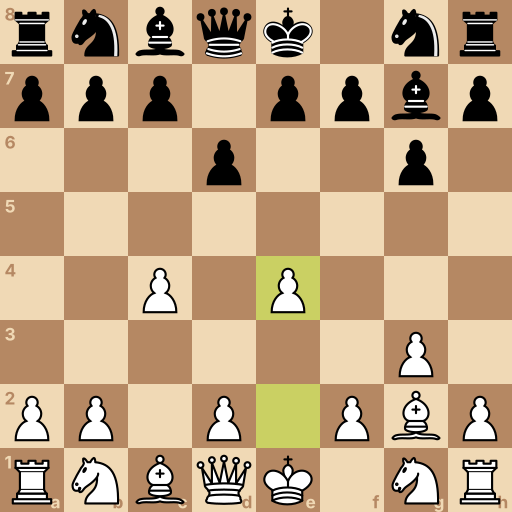
Main line: 1.g3 g6 2.Bg2 Bg7 3.c4 d6 4.e4
Position after 1.g3 g6 2.Bg2 Bg7 3.c4 d6 4.e4. Black to move.
The mirror: they copy your setup move for move.
Copying has one flaw that never goes away — you are always one move ahead, and the first to claim wins the claim.
Your move: Bishop to g2 — continue as normal. Let them keep copying.
2.Bg2 The bishop takes its corner — a move ahead in the same race.
Your move: They copy again. Now break the mirror where it pays: push c4 and claim the queenside first.
3.c4 The c-pawn claims first — the copy can only follow, never lead.
Your move: They stop copying and prop with d6 — the mirror always cracks. Take the middle they just conceded: push e4.
4.e4 The e-pawn takes the middle — the extra move became real ground.
Question: The mirror cracked and you hold c4 plus e4. What ended the copying?
Answer: The extra move — every claim you made first, they could only answer second. In a perfect mirror, who runs out of safe copies first? A copycat is always half a move late, and the first real claim forces them to respond instead of copy. You claimed twice; they blinked once; now the middle is yours and the game is your kind of game.
Final challenge: The Land Baron (800 Elo)
The opponent says: All this empty middle? Mine. I'm taking every square you leave.
Your tasks in the game, in order:
Bite the base — push c4 at their d5 pawn.
Take the base — capture on d5.
Add the second attacker — knight to c3.
They trade — take back with the b-pawn and open the second corner.
Position after 1.g3 d5 2.Bg2 e5 3.c4 Nf6 4.cxd5 Nxd5 5.Nc3 Nxc3 6.bxc3. Black to move.
History of the King's Fianchetto Opening
The King's Fianchetto Opening begins 1.g3 and is classified under ECO A00. Its name describes White's kingside fianchetto, in which Bg2 places the bishop on the long diagonal. The system became established as a flexible opening during the rise of hypermodern play in the early twentieth century.
Main ideas for White
White uses 1.g3 to prepare Bg2 without committing a central pawn, keeping several later setups available. The g2 bishop bears on d5 and the long diagonal toward b7, while c4 attacks Black's central base and Nc3 adds pressure. Against a broad center with pawns on d5 and e5, White usually attacks from the flanks before choosing d4 or e4. Black tries to secure space, develop behind the center, and limit the bishop's diagonal.
Typical plans
A common structure has White pawns on c4 and g3 against Black pawns on d5 and e5. White often exchanges cxd5, meets Nxd5 with Nc3, and may accept doubled c-pawns after Nxc3 because bxc3 opens the b-file and frees Bb2. White then challenges e5 with d4, while Black seeks activity before the center dissolves. In mirrored fianchetto structures White can claim space with c4 and e4, and Black generally counters with c5 or e5.
Common mistakes
Do not fianchetto and then leave the g2 bishop blocked by your own center; use c4 or d4 to challenge the diagonal.
Do not attack a broad pawn center with pieces alone; strike its base with c4 and add Nc3 before expecting exchanges.
Do not copy Black's waiting moves indefinitely in a mirrored setup; use the extra tempo to claim space with c4 and e4.
Related openings
English Opening1.c4 e5 2.Nc3. Grip the middle from the side and squeeze.
Réti Opening1.Nf3 d5 2.c4. Press their middle without offering a target.
King's Indian Attack1.Nf3 d5 2.g3. The same house every game, then the e5 wedge.
Bird's Opening1.f4. Claim e5 from the wing and attack the king.