You claim the middle from the side, put a bishop on the longest diagonal, and squeeze down the file your first move opened. You play the setup, both replies, and a full game against an opponent that charges the middle with pawns.
Start here
0
Chapter 1: The Sideways Claim
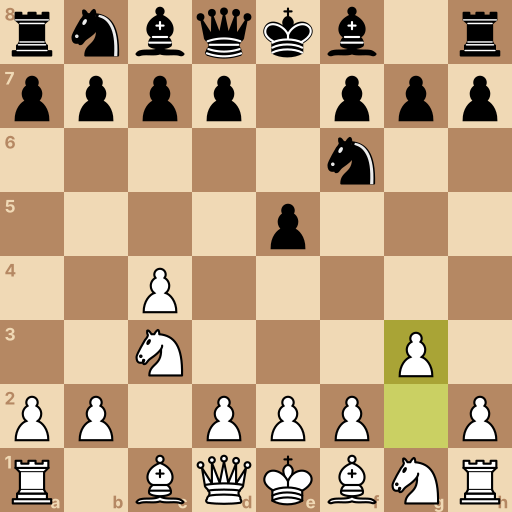
Main line: 1.c4 e5 2.Nc3 Nf6 3.g3
Position after 1.c4 e5 2.Nc3 Nf6 3.g3. Black to move.
These four squares are the middle of the board. A piece standing near them reaches everywhere; a piece stuck on the edge reaches half as far.
White moves first. Most first moves plant a pawn in the middle. This one claims a middle square from the side — and never offers a target.
Your move: Push your c-pawn two squares, to c4. It grips d5 — a middle square — without ever standing in the middle itself.
1.c4 The pawn in front of your queenside bishop — two steps to c4 grips d5 from the side.
Your move: They take the middle head-on with e5. Add a second gripper on d5 — your knight to c3.
2.Nc3 The knight beside your queen's rook — one jump to c3 adds a second claim on d5.
Your move: Their knight comes out. One small step with your g-pawn, to g3, opens the corner for your bishop — the third piece pointed at the same part of the board.
3.g3 One step with the g-pawn — it opens the long diagonal for your bishop.
Question: Three moves, and not one pawn in the middle. What is this opening actually doing?
Answer: Gripping d5 from the side so their middle can never expand. Count the pieces already aimed at one square. Pawn, knight, and soon the bishop all watch d5. Their e5 pawn stands alone and can never get a partner next to it — every time they try d5, you are there first. That grip is the English.
This is the English Opening. No targets, no early fights — just a grip that tightens.
Their most natural try is to push d5 anyway. The next chapter shows why that square belongs to you.
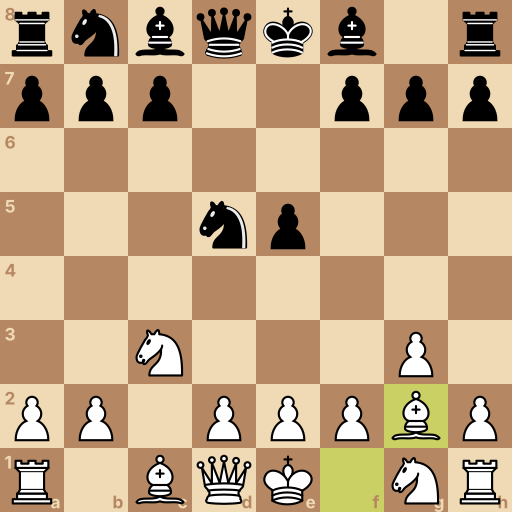
Position after 1.c4 e5 2.Nc3 Nf6 3.g3 d5 4.cxd5 Nxd5 5.Bg2. Black to move.
There it is — they push d5 into your grip. This is not a problem. It is the trade your first move was waiting for.
Your c-pawn takes, and whatever recaptures stands on a square you control.
Your move: Take the d5 pawn with your c-pawn.
4.cxd5 Your c-pawn takes on d5 — the square it has gripped since move one.
Your move: Their knight takes back and stands in the middle. Now finish the idea: bishop to g2. It stares straight at that knight — and at the whole long diagonal behind it.
5.Bg2 The king's bishop tucks into g2, onto the diagonal you opened last chapter.
Question: Why is the bishop stronger on g2 than on a middle square?
Answer: It presses the longest diagonal from a square nothing can attack. Find a piece of theirs that can ever bother the bishop on g2. From g2 the bishop watches d5, b7, and the corner beyond — and no pawn or piece can ever chase it away. A piece that presses forever without being touchable is worth more than one that stands tall for a moment.
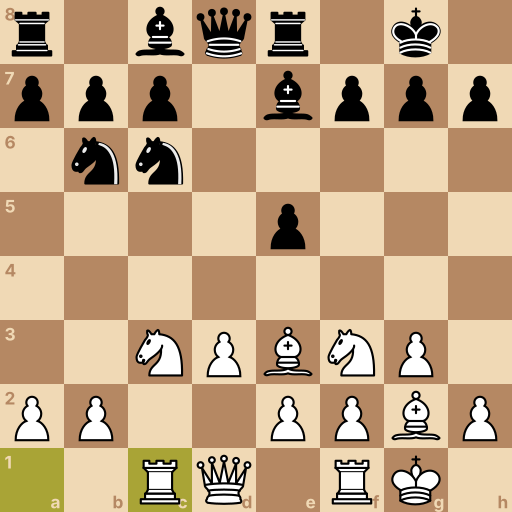
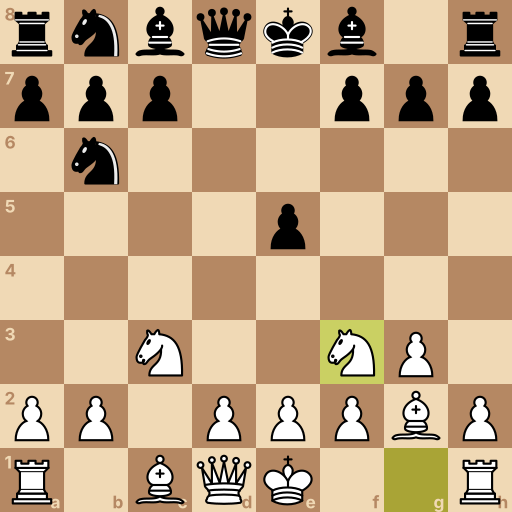
Position after 1.c4 e5 2.Nc3 Nf6 3.g3 d5 4.cxd5 Nxd5 5.Bg2 Nb6 6.Nf3 Nc6 7.O-O Be7 8.d3 O-O 9.Be3 Re8 10.Rc1. Black to move.
The grip is set. Now honest work: pieces out, king safe — and notice what your first move left behind.
Your c-pawn is gone from its file. That file is where your rook is headed.
Your move: Their knight retreats to b6, away from your bishop's stare. Bring your kingside knight to f3 — it watches e5 and d4.
6.Nf3 The knight beside your king's rook — one jump to f3, toward the middle.
Your move: They develop. Castle — two squares toward the corner, and your king tucks in behind the g2 bishop.
7.O-O Two squares toward the corner — the rook jumps over by itself.
Your move: They tuck their bishop on e7. Play the modest d3 — it guards e4 and asks nothing of the long diagonal your bishop lives on.
8.d3 One step with the d-pawn — it supports your position without blocking the g2 bishop.
Your move: They castle. Bring your dark bishop to e3 — it develops with a job: it stares at their b6 knight across the board.
9.Be3 The dark bishop steps out to e3, eyeing their b6 knight.
Your move: Their rook comes to the middle. Now the payoff of move one: slide your queen's rook to c1 — a file with no white pawn on it, aimed all the way into their camp.
10.Rc1 The rook in the far corner slides to c1, onto the half-open file.
Question: Everything is placed and the king is safe. Where does your play come from?
Answer: The queenside squeeze — rook on the c-file, bishop on the long diagonal, advance on that side. Your two best pieces both point at the same side of the board. Rook down the c-file, bishop down the long diagonal — both land on their queenside. Push your a- and b-pawns that way and something gives. The English wins slowly, on the side the opponent forgot.
Chapter 4: The Early Grab
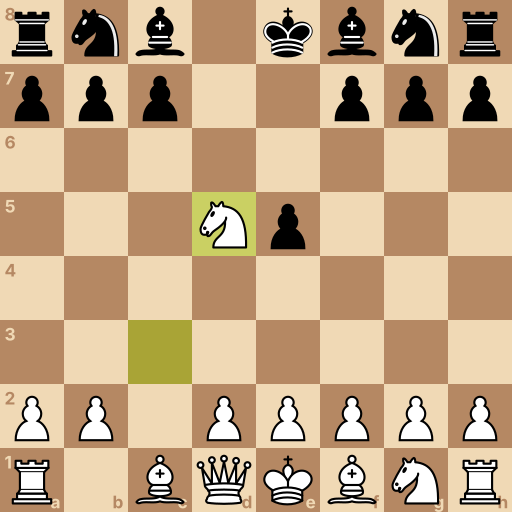
Main line: 1.c4 e5 2.Nc3 d5 3.cxd5 Qxd5 4.Nxd5
Position after 1.c4 e5 2.Nc3 d5 3.cxd5 Qxd5 4.Nxd5. Black to move.
Some opponents push d5 on move two, before developing anything. The push itself is fine — it is what comes after that goes wrong for them.
Take, and watch which piece they are tempted to bring out.
Your move: Take the d5 pawn with your c-pawn.
3.cxd5 Your c-pawn takes on d5, same as always.
Your move: They take back with the queen — and look at your c3 knight. It has been aimed at d5 since move two, and the queen has no guard. Take her.
4.Nxd5 Your knight has attacked d5 all along — the queen landed on a square you own.
Question: A whole queen on move four. Why did that happen?
Answer: The knight was aimed at d5 before she ever landed there. Count your attackers on d5 before her grab, not after. Your pawn and knight both claimed d5 from the start — she took a pawn on a square that was attacked twice and guarded once. Before any capture, count the claimers. The English sets this trap without even trying.
Final challenge: The Charger (800 Elo)
The opponent says: Side pawns? Cute. I'm taking the middle with real ones.
Your tasks in the game, in order:
Open the corner for your bishop — one step to g3.
They charge d5 — take it with your c-pawn.
Bishop to g2, onto the long diagonal.
Bring your kingside knight to f3.
Position after 1.c4 e5 2.Nc3 Nf6 3.g3 d5 4.cxd5 Nxd5 5.Bg2 Nb6 6.Nf3. Black to move.
History of the English Opening
The English Opening begins 1.c4 and spans ECO A10 through A39. Its name reflects its association with English champion Howard Staunton, who used it in his 1843 match against Pierre Charles Fournier de Saint-Amant. The opening became a regular part of international master practice during the twentieth century.
Main ideas for White
White uses 1.c4 to control d5 from the flank, then reinforces that square with the b1 knight on c3 and bishop on g2. Against 1...e5, this produces a Sicilian Defense with colors reversed and an extra tempo for White. Black usually builds a broad center with pawns on e5 and d5, while White develops quietly and attacks that center. The g2-a8 diagonal, d5 square, and half-open c-file guide placement of the white pieces.
Typical plans
When Black builds with 1.c4 e5 2.Nc3 Nf6 3.g3 d5, White can answer 4.cxd5 and leave the c-file available for a rook. White commonly castles kingside, keeps the d-pawn on d3, and develops the dark bishop before expanding on the queenside or in the center. In closed structures, White plays for space and pressure on c7 or b7, while Black seeks central or kingside activity. Typical pawn breaks advance the white b-pawn or d-pawn, while Black often advances the d-pawn or f-pawn.
Common mistakes
Advancing the d-pawn too early can block the g2 bishop; complete development and choose the central break when it improves the pieces.
Recapturing on d5 with the queen can lose material to the c3 knight; count every attacker before placing the queen in the center.
Launching queenside pawns before castling leaves the king exposed; secure the king and place a rook on the c-file first.
Related openings
Réti Opening1.Nf3 d5 2.c4. Press their middle without offering a target.
King's Indian Attack1.Nf3 d5 2.g3. The same house every game, then the e5 wedge.
Bird's Opening1.f4. Claim e5 from the wing and attack the king.