You post a bishop on the long diagonal and control e4 from a distance — no pawn ever needs to stand there. You play the setup, both replies, and a full game against an opponent that wants e4 at any cost.
Start here
0
Chapter 1: The Distance Fighter
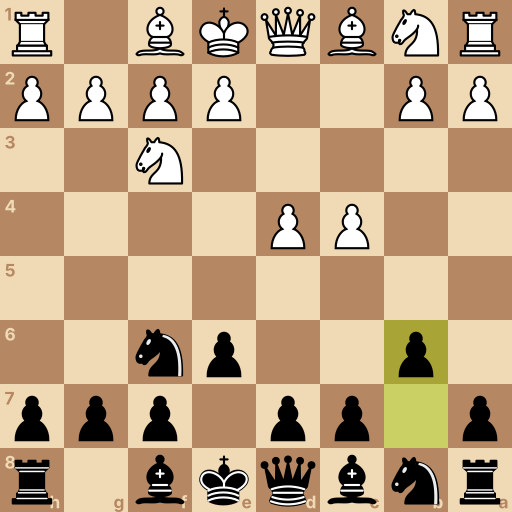
Main line: 1.d4 Nf6 2.c4 e6 3.Nf3 b6
Position after 1.d4 Nf6 2.c4 e6 3.Nf3 b6. White to move.
These four squares are the middle of the board. A piece standing near them reaches everywhere; a piece stuck on the edge reaches half as far.
White moves first and takes d4. Their next dream is e4. This defense denies it — with pieces that never leave home ground.
Your move: They open with the queen's pawn. Knight to f6 — the first watcher on e4.
1...Nf6 The knight in front of your rook — one jump to f6 watches e4.
Your move: They add c4. One step with your e-pawn keeps your options open and frees a bishop.
2...e6 One step with the e-pawn — flexible, and the dark bishop breathes.
Your move: Their knight goes to f3 — dodging the pin the Nimzo-Indian would throw at c3. Different door, same plan: one step with your b-pawn, and your bishop gets the longest diagonal on the board.
3...b6 One step with the b-pawn — the light bishop's road to e4 opens.
Question: The bishop will sit on b7, four squares from e4. How does it fight for a square that far away?
Answer: Bishops attack down the whole diagonal — distance costs them nothing. Trace the diagonal from b7 and count the squares it touches. From b7 the bishop hits c6, d5, e4 — all the way to their king's corner. A bishop controls its whole diagonal at once, so e4 is watched as firmly from b7 as from next door. Control at a distance is this defense's whole idea.
This is the Queen's Indian Defense — the Nimzo's calm sister, played when their knight picks f3 over c3.
Next the bishop takes its post and the little house goes up around it.
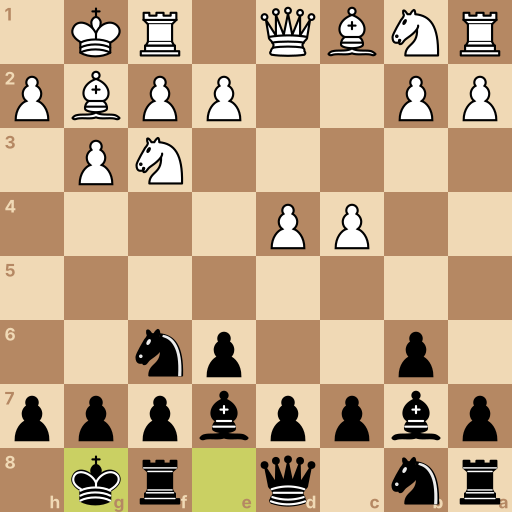
Position after 1.d4 Nf6 2.c4 e6 3.Nf3 b6 4.g3 Bb7 5.Bg2 Be7 6.O-O O-O. White to move.
They answer your corner bishop with one of their own — g3 and Bg2 coming, staring down the same diagonal from the other end.
Good. Post yours first and let the two watch each other while you finish the house.
Your move: Bishop to b7 — onto the long diagonal, watching e4 from home.
4...Bb7 The bishop takes its post on b7 and controls the diagonal.
Your move: Their bishop takes its corner. Yours steps to e7 — modest, solid, clearing the castle.
5...Be7 The dark bishop steps to e7 and clears the runway for your king.
Your move: They castle. Castle too — two squares toward the corner.
6...O-O Two squares toward the corner — the rook jumps over by itself.
Question: Both sides castled, both bishops posted, and not a single capture yet. Who is this quiet position better for?
Answer: You're fine — they still can't play e4, which is all this opening promises. Check the e4 square one more time: who watches it, who wants it? Knight and bishop cover e4; if they ever force it, it costs them. Your position has no weakness to attack, and your play comes at the moment they overreach. Solid is the point — the Queen's Indian wins by never losing first.
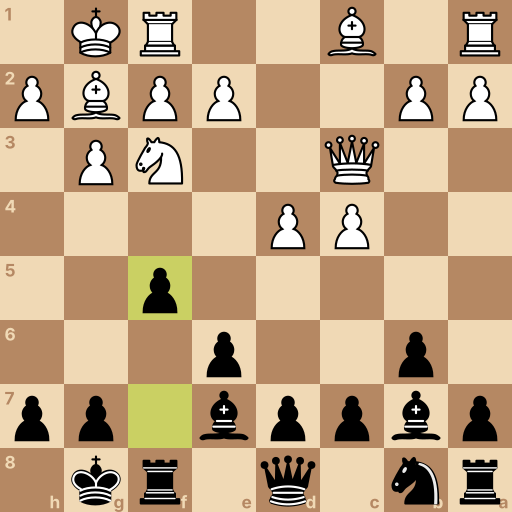
Position after 1.d4 Nf6 2.c4 e6 3.Nf3 b6 4.g3 Bb7 5.Bg2 Be7 6.O-O O-O 7.Nc3 Ne4 8.Qc2 Nxc3 9.Qxc3 f5. White to move.
There it is — their knight finally comes to c3, and the e4 push is one move away.
Beat them to the square: if e4 is going to be occupied, occupy it yourself.
Your move: Jump your knight to e4 — your bishop guards it from b7, and the square they wanted is taken.
7...Ne4 The knight lands on e4 first, guarded by the b7 bishop.
Your move: Their queen pokes at the knight. Trade it for the c3 knight — you gave the square's visitor, they lose the square's fighter.
8...Nxc3 Trade the knights — their last real e4-fighter leaves the board.
Your move: Their queen takes back. Now nail the square shut for the rest of the game: push f5. With pawn and bishop both holding e4, no white piece ever lands there.
9...f5 The f-pawn, two steps — it clamps e4 shut for good.
Question: The square they built toward all game is sealed. Where does your play go now?
Answer: The f-file and kingside — the f5 pawn is the front of an attack, not just a lock. The clamp pawn is also an advancing pawn — look where f5 points. The rook already stands behind f5; the bishop aims through the same neighborhood; f4 comes when you're ready. What began as defense of one square turns into your kingside play — the Queen's Indian's quiet trick.
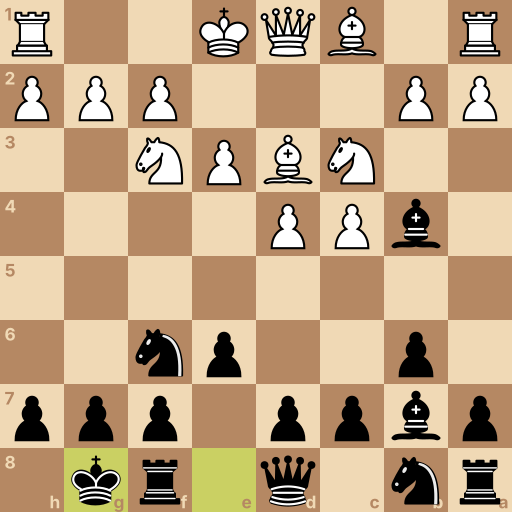
Position after 1.d4 Nf6 2.c4 e6 3.Nf3 b6 4.Nc3 Bb4 5.e3 Bb7 6.Bd3 O-O. White to move.
The direct try: knight to c3 right now, aiming to push e4 before you settle in.
Borrow a move from the sister opening — the pin works here too.
Your move: Bishop to b4 — pin the c3 knight before it can support anything.
4...Bb4 The bishop pins the c3 knight — the e4 plan freezes on the spot.
Your move: They shore up quietly. Finish your own plan: bishop to b7, the long diagonal.
5...Bb7 The light bishop takes b7 — both of your bishops now have jobs.
Your move: They develop. Castle — two squares toward the corner, everything in order.
6...O-O Two squares toward the corner — the rook jumps over by itself.
Question: Their direct try met a pin and a posted bishop. Count the e4 fight now.
Answer: You win it — knight and bishop watch, their knight is pinned, their push would just lose material. Same count as always: real watchers versus frozen ones. Knight on f6, bishop on b7 — two live fighters. Their c3 knight is pinned and their e4 push drops a pawn to your pieces. Whether they come slow or fast, this defense answers the same question the same way: e4 is not theirs.
Final challenge: The Occupier (800 Elo)
The opponent says: e4 is mine. I'm putting a pawn there if it takes all game.
Your tasks in the game, in order:
Open the bishop's road — one step to b6.
Post the bishop on b7, watching e4 from home.
Bishop to e7 — clear the castle.
Castle — the house is done and e4 still isn't theirs.
Position after 1.d4 Nf6 2.c4 e6 3.Nf3 b6 4.g3 Bb7 5.Bg2 Be7 6.O-O O-O. White to move.
History of the Queen's Indian Defense
The Queen's Indian Defense begins 1.d4 Nf6 2.c4 e6 3.Nf3 b6 and occupies ECO codes E12 through E19. Its name reflects the queenside fianchetto of Black's queen bishop within the Indian family of defenses. It became an established part of master practice during the 1920s.
Main ideas for Black
Black places the light-squared bishop on b7 to pressure e4 along the b7-e4 diagonal while the f6 knight controls the same square. The dark-squared bishop usually develops to e7 or b4, and Black castles before deciding between a central break or a kingside expansion. White normally fianchettos the king bishop or develops the b1 knight to c3, then tries to build e4 and use the extra central space.
Typical plans
Black often reaches a restrained center with pawns on e6 and either d5 or c5, then challenges White before the central space becomes stable. Against a kingside fianchetto, the f6 knight can occupy e4 and exchange on c3, while the f-pawn may advance to f5. White seeks e4 and queenside space; Black counters on the light squares, the c-file, or the kingside according to the structure.
Common mistakes
Do not play the queenside fianchetto mechanically after White establishes e4; challenge the center immediately with a pawn break or piece pressure.
A common error is trading the b7 bishop without gaining anything; preserve it when its pressure on e4 and the long diagonal matters.
Castling late leaves Black unable to react in the center, so secure the king before starting play with f5 or c5.
Related openings
King's Indian Defense1.d4 Nf6 2.c4 g6. Let them build the middle, then strike it down.
Slav Defense1.d4 d5 2.c4 c6. Guard the middle and keep your bishop free.
Dutch Defense1.d4 f5. Claim e4 with a wing pawn and storm their king.
Grünfeld Defense1.d4 Nf6 2.c4 g6 3.Nc3 d5. Hand them the big middle, then hammer it.
Nimzo-Indian Defense1.d4 Nf6 2.c4 e6 3.Nc3 Bb4. Pin the knight and own e4 without a pawn.
Bogo-Indian Defense1.d4 Nf6 2.c4 e6 3.Nf3 Bb4+. A check on move three that develops for free.
Benoni Defense1.d4 Nf6 2.c4 c5 3.d5 e6. Lure the push, then march your majority.
Benko Gambit1.d4 Nf6 2.c4 c5 3.d5 b5. One pawn buys two open files, forever.