You give a check on move three that develops a piece for free, then build a simple house around the e5 square. You play the check, both replies, and a full game against an opponent that blocks everything.
Start here
0
Chapter 1: The Free Check
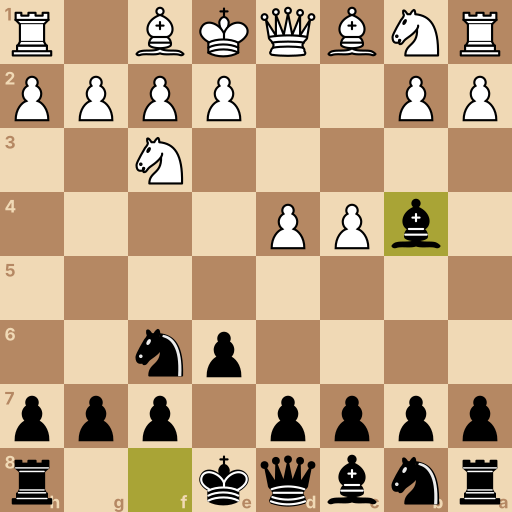
Main line: 1.d4 Nf6 2.c4 e6 3.Nf3 Bb4+
Position after 1.d4 Nf6 2.c4 e6 3.Nf3 Bb4+. White to move.
These four squares are the middle of the board. A piece standing near them reaches everywhere; a piece stuck on the edge reaches half as far.
White moves first and starts building. This defense interrupts the building with a check — and checks always jump the queue.
Your move: They open with the queen's pawn. Knight to f6 — toward the middle, watching e4.
1...Nf6 The knight in front of your rook — one jump to f6, toward the middle.
Your move: They add c4. One step with your e-pawn opens the dark bishop's road.
2...e6 One step with the e-pawn — the dark bishop's diagonal opens.
Your move: Their knight takes f3. Now the Bogo move: bishop to b4, with check. They must stop building and answer you.
3...Bb4+ The bishop lands on b4 with check — their plans wait, yours don't.
Question: What does a developing move with check actually earn you?
Answer: Tempo — your piece is out, and their reply is forced to be about you. They can't play the move they wanted — they must answer the check. The check costs them their turn's freedom. Whatever blocks the check is a move shaped by you, not by their plan. Three moves in, you are the one asking questions — that is the Bogo-Indian.
This is the Bogo-Indian Defense — the check-first cousin of the Indian defenses.
They block with the bishop or the knight. The next chapters answer both.
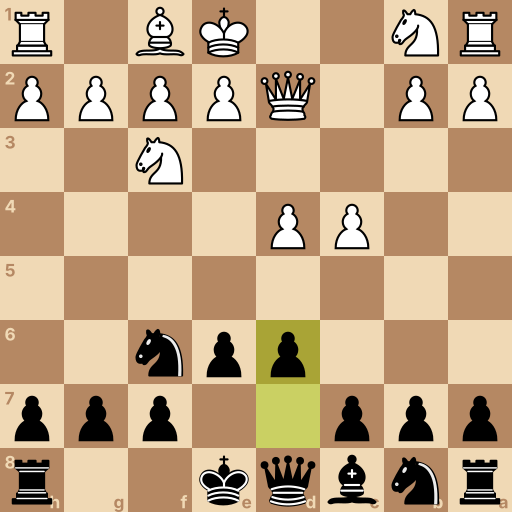
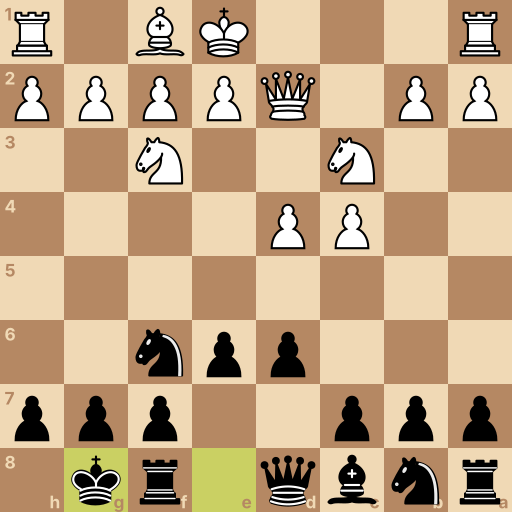
Position after 1.d4 Nf6 2.c4 e6 3.Nf3 Bb4+ 4.Bd2 Bxd2+ 5.Qxd2 d6. White to move.
They block with the bishop — the main answer. Trade, and be glad about it.
Your coming pawns will live on dark squares; the bishop you are trading would have been staring at their backs all game.
Your move: Take their bishop, with check again.
4...Bxd2+ Trade the bishops — yours was about to live behind its own pawns.
Your move: Their queen takes back. Now place the pawn that shapes your whole game: d6, guarding the e5 square your plan is built around.
5...d6 One step with the d-pawn — it guards e5, the square your game runs through.
Question: You traded your dark bishop, then put pawns on dark squares. Why is that the right order?
Answer: Pawns on dark squares would have buried that bishop; trading it first costs nothing. Picture the bishop on e7 with your pawns on d6 and e5 in front of it. With d6 and e5 coming, the dark bishop would have spent the game staring at its own pawns. You traded it while it still had full value — for their good bishop, with a check thrown in. Structure first, and no bad pieces left behind.
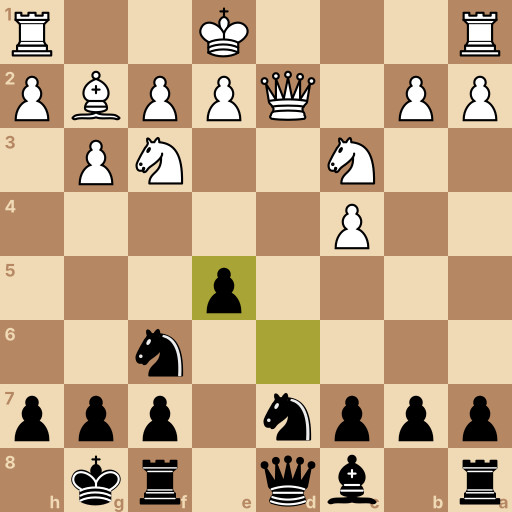
Position after 1.d4 Nf6 2.c4 e6 3.Nf3 Bb4+ 4.Bd2 Bxd2+ 5.Qxd2 d6 6.Nc3 O-O 7.g3 Nbd7 8.Bg2 e5 9.dxe5 dxe5. White to move.
The trade is done and the prop is set. Now the simple life: castle, bring the knight behind the break, and play e5.
Everything lands on schedule — that is this opening's luxury.
Your move: Castle — two squares toward the corner.
6...O-O Two squares toward the corner — the rook jumps over by itself.
Your move: They set up their bishop. Bring your other knight to d7 — tucked behind the coming e5 break, ready to support it.
7...Nbd7 The knight beside your rook tucks into d7, behind the break.
Your move: Their bishop takes its corner. Now the move everything prepared: push e5 and stake your claim in the middle.
8...e5 The e-pawn steps to e5 — guarded by d6 and the d7 knight, right on time.
Your move: They trade pawns in the middle. Take back with your d-pawn and keep your stake.
9...dxe5 The d6 prop takes back on e5 — your pawn holds the middle.
Question: Your pawn stands on e5 and nothing of yours is loose. What does the position want from you now?
Answer: Calm improvement — queen up, rooks to the middle files, and let e5 anchor everything. The pawn on e5 is an anchor, not a race — build around it. Queen to e7, rooks to d8 and e8, knights on their best squares. Even if queens come off along the way, your anchored middle and active rooks carry the game. Simple plans, executed on time — the Bogo way.
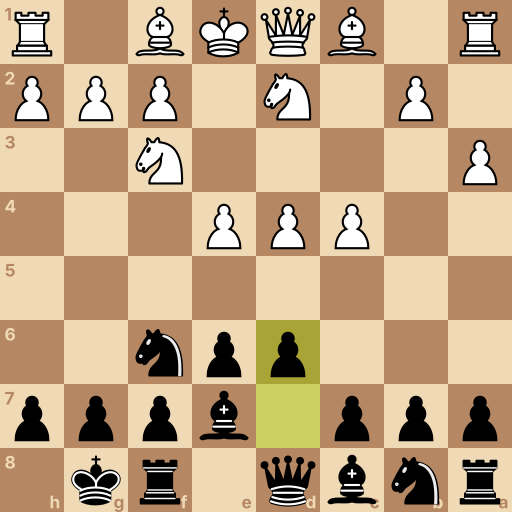
Position after 1.d4 Nf6 2.c4 e6 3.Nf3 Bb4+ 4.Nbd2 O-O 5.a3 Be7 6.e4 d6. White to move.
The other block: the queenside knight steps in the way. Now don't trade — a bishop for that awkward knight is a gift to them.
Keep the bishop, keep the pressure, and make the block itself a problem.
Your move: Castle — the check did its job; no need to hurry the bishop anywhere.
4...O-O Two squares toward the corner — the bishop stays and keeps pressing.
Your move: They spend a move on a3 to finally ask the bishop. Step it back to e7 — they used two pawn-and-block moves dealing with it; you used none.
5...Be7 The bishop retreats to e7 with the accounts in your favor.
Your move: They push e4 — but look at their d2 knight: it blocks its own bishop and queen. Play d6 and set your normal game against their tangled pieces.
6...d6 One step with the d-pawn — your usual structure against their tangle.
Question: The knight block let them keep pieces on. What did it cost them instead?
Answer: A tangle — the d2 knight blocks its own bishop and queen while you develop freely. Find the c1 bishop's and d1 queen's roads out, then look at d2. Their knight sits where the bishop and queen want to breathe, and the a3 poke was a pawn move, not development. You castled, kept the bishop, and set your structure. Same story as always: the check was free, and everything after it came with interest.
Final challenge: The Blocker (800 Elo)
The opponent says: Check me all you want. I've got a block for everything.
Your tasks in the game, in order:
Give the free check — bishop to b4.
They block with the bishop — trade it off.
Set the prop — one step to d6, guarding e5.
Castle — the house is up, the break comes next.
Position after 1.d4 Nf6 2.c4 e6 3.Nf3 Bb4+ 4.Bd2 Bxd2+ 5.Qxd2 d6 6.Nc3 O-O. White to move.
History of the Bogo-Indian Defense
The Bogo-Indian Defense begins 1.d4 Nf6 2.c4 e6 3.Nf3 Bb4+ and is classified under ECO code E11. It is named after Efim Bogoljubow, whose surname supplied the shortened Bogo form. The defense entered established master practice during the 1920s as an alternative to Queen's Indian structures.
Main ideas for Black
Black develops with check on 3...Bb4+, forcing White to answer before completing normal development and controlling e4 with the f6 knight. After 4.Bd2, exchanging bishops can suit a dark-square structure with pawns on d6 and e5. After 4.Nbd2, Black usually keeps the bishop because the d2 knight obstructs White's c1 bishop and queen. White seeks e4, more central space, and the bishop pair when Black exchanges.
Typical plans
Black usually castles quickly, develops the b8 knight to d7, and prepares the e5 break with support from d6. In the bishop-block line, exchanging on d2 removes Black's potentially restricted dark-squared bishop before pawns occupy dark squares. White tries to use central space and the bishop pair, while Black places rooks on the d-file and e-file, improves the remaining pieces, and challenges d4 or expands on the queenside.
Common mistakes
Do not exchange on d2 after 4.Nbd2 automatically; keep the bishop and let White's blocking knight restrict the queen and c1 bishop.
Playing e5 before supporting it can lose central control, so prepare the break with d6 and the b8 knight on d7.
Do not spend extra tempi chasing material after the check; castle and complete development while White resolves the awkward piece placement.
Related openings
King's Indian Defense1.d4 Nf6 2.c4 g6. Let them build the middle, then strike it down.
Slav Defense1.d4 d5 2.c4 c6. Guard the middle and keep your bishop free.
Dutch Defense1.d4 f5. Claim e4 with a wing pawn and storm their king.
Grünfeld Defense1.d4 Nf6 2.c4 g6 3.Nc3 d5. Hand them the big middle, then hammer it.
Nimzo-Indian Defense1.d4 Nf6 2.c4 e6 3.Nc3 Bb4. Pin the knight and own e4 without a pawn.
Queen's Indian Defense1.d4 Nf6 2.c4 e6 3.Nf3 b6. Control e4 from the corner, at a distance.
Benoni Defense1.d4 Nf6 2.c4 c5 3.d5 e6. Lure the push, then march your majority.
Benko Gambit1.d4 Nf6 2.c4 c5 3.d5 b5. One pawn buys two open files, forever.