You hand them the biggest pawn middle in chess — then hammer it with your bishop, your c-pawn, and everything else you own. You play the counterattack, both replies, and a full game against an opponent that builds and builds.
Start here
0
Chapter 1: The Dare
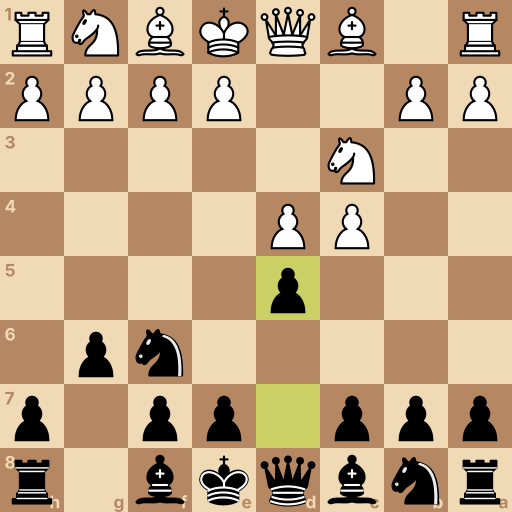
Main line: 1.d4 Nf6 2.c4 g6 3.Nc3 d5
Position after 1.d4 Nf6 2.c4 g6 3.Nc3 d5. White to move.
These four squares are the middle of the board. A piece standing near them reaches everywhere; a piece stuck on the edge reaches half as far.
White moves first and wants the middle. This defense doesn't just allow it — it dares them to take everything.
Your move: They open with the queen's pawn. Bring your kingside knight to f6 — it watches e4 from the side.
1...Nf6 The knight in front of your rook — one jump to f6, toward the middle.
Your move: They add c4. One step with your g-pawn opens the long diagonal — home for the bishop your whole plan runs through.
2...g6 One step with the g-pawn — it opens the door for your dark bishop.
Your move: Their knight comes out. Now the Grünfeld move: push d5 and strike the middle right now, before your bishop has even moved.
3...d5 The d-pawn, two steps — the strike comes now, not later.
Question: If they take on d5 and push e4, they get the biggest pawn middle in chess. Why offer them that?
Answer: A big middle is a big target — your bishop and c5 break are aimed straight at it. Look at the diagonal you opened and the c-pawn still at home. Their center will be huge — and every piece you develop will hit it. Bishop from g7, pawn break with c5, knight to c6, pins on the defenders. The Grünfeld trades ground for targets, on purpose.
This is the Grünfeld Defense. The dare is on the table.
The main line takes it: they capture, you capture, and their pawns roll forward. The next chapter walks through it calmly.
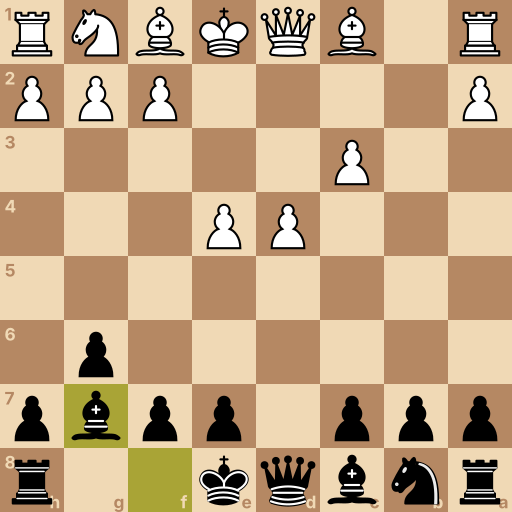
Position after 1.d4 Nf6 2.c4 g6 3.Nc3 d5 4.cxd5 Nxd5 5.e4 Nxc3 6.bxc3 Bg7. White to move.
They take. Take back with the knight — it stands in the middle for now.
They will kick it with e4 and trade it off. That is fine: every trade here is part of the plan.
Your move: Take back with your knight.
4...Nxd5 The f6 knight takes back on d5.
Your move: They kick with e4. Trade: take their c3 knight — the trade pulls a second pawn onto the c-file, doubling their pawns.
5...Nxc3 The kicked knight takes on c3 and wrecks their pawn file on the way out.
Your move: They take back, and there it is — the huge middle: pawns on c3, d4, e4. Now aim at it: bishop to g7, staring down the long diagonal at d4.
6...Bg7 The dark bishop takes the long diagonal, aimed straight at their d4 pawn.
Question: Their middle looks like a fortress. What is it really?
Answer: The target — c5 comes next and every piece joins the hammering. Count what already aims at d4, and what can aim at it next. The bishop hits d4 already; c5 attacks it next move, a knight comes to c6, and the doubled c-pawns can never help each other. The fortress has one job — surviving you — and that gets harder every move.
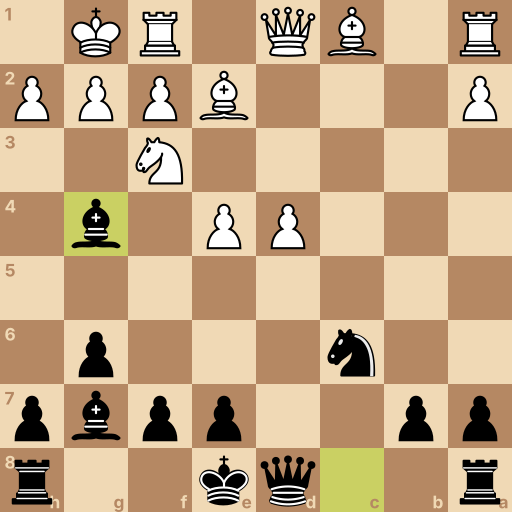
Position after 1.d4 Nf6 2.c4 g6 3.Nc3 d5 4.cxd5 Nxd5 5.e4 Nxc3 6.bxc3 Bg7 7.Nf3 c5 8.Be2 Nc6 9.O-O cxd4 10.cxd4 Bg4. White to move.
They develop and hold the wall. Time to swing the first real hammer.
Your c-pawn attacks d4, and from here every developing move you make adds another blow.
Your move: Push c5 — the hammer blow at the base of their middle.
7...c5 The c-pawn, two steps — it attacks d4 alongside your bishop.
Your move: They develop. Knight to c6 — a third attacker on d4.
8...Nc6 The knight beside your rook jumps to c6 — three attackers on d4 now.
Your move: They castle. Trade the first brick out of the wall: take on d4 with your c-pawn.
9...cxd4 Your c-pawn takes on d4 and pulls the wall apart.
Your move: They rebuild with the c-pawn — but now that pawn is pinned down by three of your pieces' attention. Pin its guard: bishop to g4, onto the f3 knight.
10...Bg4 The light bishop pins the f3 knight — d4's best guard is frozen.
Question: The wall is down to one pawn and its guard is pinned. What is the standing plan?
Answer: Keep every piece pointed at d4 until it falls or they give something up to save it. The whole opening was aimed at one square — don't change targets now. Castle, put the rook on c8 or d8, and keep the pressure. Defending one pawn with half an army leaves the rest of the board to you — and if the pawn falls, the long diagonal opens all the way. The dare has paid off.
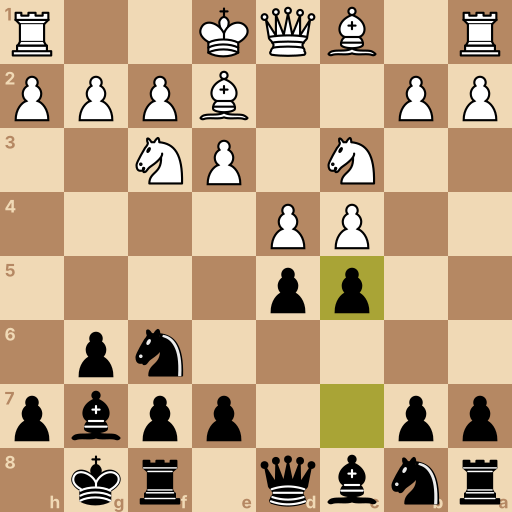
Position after 1.d4 Nf6 2.c4 g6 3.Nc3 d5 4.e3 Bg7 5.Nf3 O-O 6.Be2 c5. White to move.
Some opponents refuse the dare — a quiet e3 instead of taking. No big middle for them, no target for you.
Except now you get everything you wanted for free.
Your move: Bishop to g7 — the long diagonal, as always.
4...Bg7 The dark bishop takes its diagonal — nothing about your plan changes.
Your move: They develop. Castle — two squares toward the corner.
5...O-O Two squares toward the corner — the rook jumps over by itself.
Your move: They keep building slowly. Strike with c5 anyway — the same hammer, and this time their middle never even got big enough to scare anyone.
6...c5 The c-pawn strikes at d4 — the Grünfeld plan works here too.
Question: They declined the dare. What did their caution buy them?
Answer: Nothing — you got your dream setup and they locked in their own bishop. Find their c1 bishop's road out from behind the e3 pawn. Their e3 pawn walled in their own bishop, and you developed with strikes for free: fianchetto, castle, c5, all on schedule. Declining the Grünfeld's dare doesn't dodge the plan — it just faces it with less.
Final challenge: The Builder (800 Elo)
The opponent says: Go ahead, hand me the middle. I'll build a wall you can't touch.
Your tasks in the game, in order:
Make the dare — strike with d5.
They take — take back with the knight.
They kick with e4 — trade on c3 and double their pawns.
Aim the hammer — bishop to g7, at the wall.
Position after 1.d4 Nf6 2.c4 g6 3.Nc3 d5 4.cxd5 Nxd5 5.e4 Nxc3 6.bxc3 Bg7. White to move.
History of the Grünfeld Defense
The Grünfeld Defense begins 1.d4 Nf6 2.c4 g6 3.Nc3 d5 and occupies ECO codes D70 through D99. It is named for Ernst Grünfeld, who introduced it to top-level tournament play in 1922 and defeated Alexander Alekhine with it in Vienna that year. The opening soon became an established answer to 1.d4 based on piece pressure against the white center.
Main ideas for Black
Black allows White to build a broad pawn center, then attacks its base rather than occupying the center with pawns. The g7 bishop pressures d4 along the long diagonal, the c5 pawn break adds a direct attack, and the b8 knight can join from c6. White usually accepts with 4.cxd5 Nxd5 5.e4, using space and central pawns to support active pieces, while Black tries to prove that the center is overextended.
Typical plans
In the Exchange Variation, White often has pawns on c3, d4, and e4 after 4.cxd5 Nxd5 5.e4 Nxc3 6.bxc3. Black normally develops the bishop to g7, strikes with the c-pawn at c5, develops the b8 knight to c6, and castles kingside before placing rooks on c8 or d8. White seeks central expansion and kingside activity, while Black opens the c-file or long diagonal by exchanging on d4 and may pin the f3 knight with the c8 bishop.
Common mistakes
Taking on c3 without following with pressure on d4 only helps White's development; use the doubled pawns as targets immediately.
Delaying the c5 break lets White consolidate the center; develop the g7 bishop and attack d4 before White completes development.
Attacking the center while leaving the king uncastled can backfire tactically; coordinate the queenside pieces and castle before increasing pressure.
Related openings
King's Indian Defense1.d4 Nf6 2.c4 g6. Let them build the middle, then strike it down.
Slav Defense1.d4 d5 2.c4 c6. Guard the middle and keep your bishop free.
Dutch Defense1.d4 f5. Claim e4 with a wing pawn and storm their king.
Nimzo-Indian Defense1.d4 Nf6 2.c4 e6 3.Nc3 Bb4. Pin the knight and own e4 without a pawn.
Queen's Indian Defense1.d4 Nf6 2.c4 e6 3.Nf3 b6. Control e4 from the corner, at a distance.
Bogo-Indian Defense1.d4 Nf6 2.c4 e6 3.Nf3 Bb4+. A check on move three that develops for free.
Benoni Defense1.d4 Nf6 2.c4 c5 3.d5 e6. Lure the push, then march your majority.
Benko Gambit1.d4 Nf6 2.c4 c5 3.d5 b5. One pawn buys two open files, forever.