White builds the same solid house nearly every game: queen's pawn forward, bishop out before the wall goes up. You play the setup, the answer to the queen raid on b2, and a full game against an opponent that hunts your pawns.
Start here
0
Chapter 1: The Setup
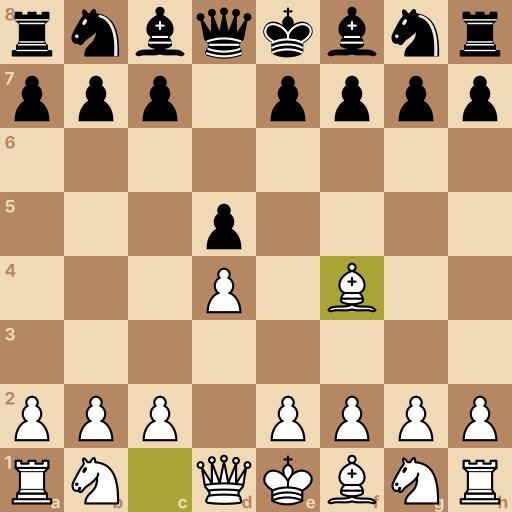
Main line: 1.d4 d5 2.Bf4
Position after 1.d4 d5 2.Bf4. Black to move.
Every opening starts as a fight over these four middle squares. A piece in the middle reaches the whole board; a piece stuck at home reaches almost nothing.
White moves first, so you take one of the four right away.
Your move: Push the pawn in front of your queen two squares, to d4, and take your first middle square.
1.d4 Try the pawn in front of your queen — two steps to d4 grabs the middle.
Your move: They answer with d5 and the pawns lock. Now the London move: your dark bishop out to f4, before any wall pawn can shut its door.
2.Bf4 Bring the dark bishop out to f4 while its door is still open.
Question: Your bishop jumped out before your e-pawn moved. Why does the order matter?
Answer: Pawn e3 first would lock the bishop behind its own wall. Picture e3 played first — the bishop's door closes on it forever. Play e3 first and that bishop stares at its own pawn all game. Bishop out first, wall second — that order is the whole opening.
That is the London System: d4, the bishop to f4, then the same pawn wall on e3 and c3 nearly every game. No long move lists to remember.
They can develop quietly, send their queen after your b2 pawn, or put a bishop in the corner. You will learn all three.
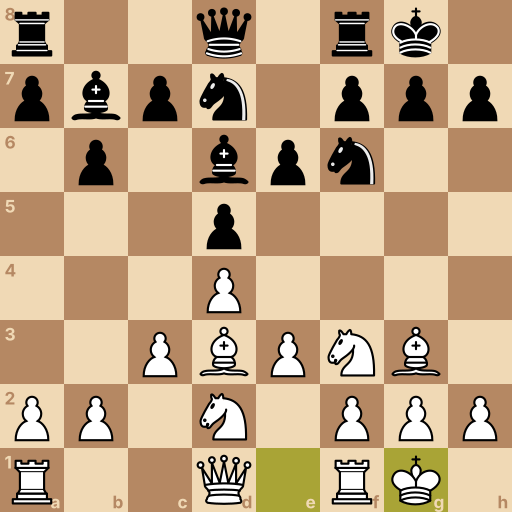
Position after 1.d4 d5 2.Bf4 Nf6 3.e3 e6 4.Nf3 Bd6 5.Bg3 O-O 6.Bd3 Nbd7 7.Nbd2 b6 8.c3 Bb7 9.O-O. Black to move.
Their knight comes out and waits to see your plan. The London answers almost everything the same way: a pawn wall on e3 and c3, with your bishop already outside it.
This chapter is the full house, brick by brick, ending with your king castled.
Your move: Lay the first brick — push your e-pawn one square to e3, propping up d4 with your bishop safely outside.
3.e3 One small step — e3 props up d4, and your bishop is already out.
Your move: They play e6 and lock their own bishop in — the mistake your move order avoided. Bring your knight to f3.
4.Nf3 Hop the knight to f3 — it watches e5 and clears your kingside.
Your move: Their bishop lands on d6 and offers to trade off your London bishop. Don't give it up — tuck it back to g3.
5.Bg3 Slide the bishop back to g3 — it stays on its diagonal, out of reach.
Your move: They castle. Point your light bishop at their king — bishop to d3.
6.Bd3 Bishop to d3 — its diagonal runs straight at their castled king.
Your move: Their other knight settles on d7. Mirror it — your last knight to d2, ready to jump through the middle later.
7.Nbd2 Knight to d2 — it backs up its brother and eyes e4 and c4.
Your move: They prepare their bishop with b6. Lay the last brick — pawn to c3, and d4 can never be shaken.
8.c3 Pawn to c3 finishes the wall — three pawns holding the middle.
Your move: Their bishop settles on b7. The house is built, so castle — slide your king two squares right.
9.O-O Time to castle — slide your king two squares to the right.
Question: So what is the London plan?
Answer: The same wall every game, bishop outside it, king safe. The wall and the outside bishop are the whole opening — the same house every game. e3 and c3 hold d4, the bishop breathes on g3, and your king is tucked away. You can build this same house against almost anything they try.
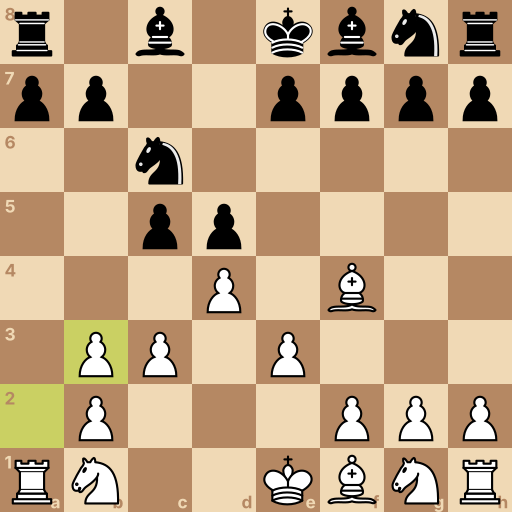
Position after 1.d4 d5 2.Bf4 c5 3.e3 Nc6 4.c3 Qb6 5.Qb3 Qxb3 6.axb3. Black to move.
Their c-pawn hits d4 and opens the road for their queen. The plan they dream of: queen to b6, then the b2 pawn — the one square your bishop left behind.
You will meet the raid head on, and their hunt will hand you an open file.
Your move: First things first: their pawn leans on d4, so prop it up — push your e-pawn to e3.
3.e3 One step — e3 keeps d4 standing.
Your move: Their knight joins in — a second attacker on d4. Add the second guard with pawn to c3.
4.c3 Pawn to c3 — two guards for two attackers, d4 holds.
Your move: There it is — queen to b6, glaring at b2. Don't hide. Meet her face to face with your queen to b3.
5.Qb3 Send your queen to b3 — she guards b2 and offers the trade.
Your move: They trade queens on b3. Take back with your a-pawn — and watch your rook wake up.
6.axb3 Take back with the a-pawn — it opens the whole file for your rook.
Question: They went pawn hunting and the queens came off. Who is happy?
Answer: You — b2 never fell and your rook got an open file. Look at your a1 rook — their hunt bought you a whole open file. The b2 pawn never fell, the queens are gone, and your rook stares down the open a-file. Their big raid bought them nothing.
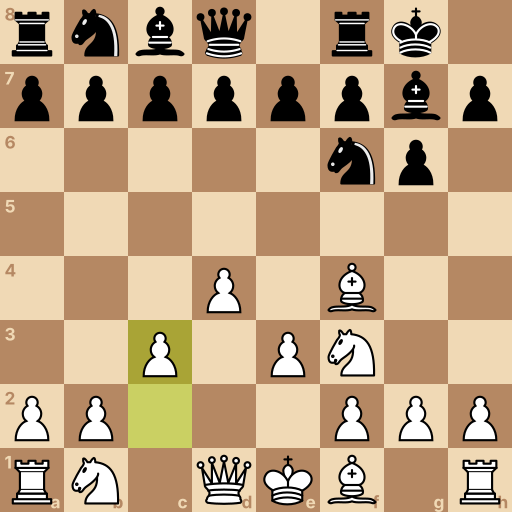
Position after 1.d4 Nf6 2.Bf4 g6 3.e3 Bg7 4.Nf3 O-O 5.c3. Black to move.
No pawn meets you in the middle — they will watch it from the corner instead, with a bishop on g7 aiming across at d4.
The London does not change. Same wall, same bishop outside it, and you keep the extra space they gave up.
Your move: Start the wall the way you always do — pawn to e3.
3.e3 Same first brick as always — e3, with the bishop already out.
Your move: Their bishop settles into the corner, aiming at d4 from afar. Bring your knight to f3, standing guard in the middle.
4.Nf3 Knight to f3 — it covers e5 and clears the way to castle.
Your move: They castle early. Finish the wall with pawn to c3 — now their corner bishop bites on stone.
5.c3 Pawn to c3 — the wall stands, and the long diagonal is closed for business.
Question: So what changes against the fianchetto?
Answer: Nothing — the same wall works, and you own more middle. The wall does not care — it stands the same, and you keep the extra space. e3, c3 and the outside bishop — the same house you always build. Their corner bishop hits your wall and stops. You simply have more of the board.
Final challenge: The Pawn Grabber (800 Elo)
The opponent says: Your b2 pawn looks free to me. I'm coming for it.
Your tasks in the game, in order:
Their c-pawn leans on d4. Prop it up — pawn to e3.
A second attacker on d4. Add the second guard — pawn to c3.
Their queen glares at b2. Meet her — queen to b3.
Take back on b3 with your a-pawn.
Position after 1.d4 d5 2.Bf4 c5 3.e3 Nc6 4.c3 Qb6 5.Qb3 Qxb3 6.axb3. Black to move.
History of the London System
The London System is built around 1.d4 d5 2.Bf4 and is commonly classified under ECO D02; its name comes from the London tournament of 1922. The setup became established during the 1920s as White combined an early dark-squared bishop development with pawns on e3 and c3 and a knight on f3 rather than entering sharper queen-pawn theory.
Main ideas for White
White develops the dark-squared bishop to f4 before playing e3, then supports d4 with the pawn chain on c3, d4, and e3. A knight on f3 controls e5, the queenside knight on d2 supports e4 and c4, and the light-squared bishop can point toward h7. Black usually challenges d4 with the c-pawn, attacks b2 with a queen on b6, or fianchettos the king bishop on g7.
Typical plans
London middlegames usually retain a compact chain on c3, d4, and e3 while White completes development and castles kingside. White often plants a knight on e5, prepares the e4 break, or expands on the kingside after the center is secure. Black seeks activity against d4 and b2, often using the c5 break or queenside pressure; White can also use c4 to challenge a fixed d5 pawn.
Common mistakes
Advancing the e-pawn before developing the dark-squared bishop locks that bishop behind its own pawn, so move the bishop first.
Defending b2 passively against a queen on b6 can lose time; meet the queen with your queen on b3 when a trade is sound.
Repeating the standard setup without checking the center can miss a direct attack on d4; count attackers and reinforce the pawn promptly.
Related openings
Queen's Gambit1.d4 d5 2.c4. Offer the c-pawn and take the middle either way.
Catalan Opening1.d4 Nf6 2.c4 e6 3.g3 d5 4.Bg2. One bishop presses their queenside all game.
Trompowsky Attack1.d4 Nf6 2.Bg5. Bishop out on move two, their prep out the window.
King's Indian Defense1.d4 Nf6 2.c4 g6. Let them build the middle, then strike it down.
Slav Defense1.d4 d5 2.c4 c6. Guard the middle and keep your bishop free.
Dutch Defense1.d4 f5. Claim e4 with a wing pawn and storm their king.
Grünfeld Defense1.d4 Nf6 2.c4 g6 3.Nc3 d5. Hand them the big middle, then hammer it.
Nimzo-Indian Defense1.d4 Nf6 2.c4 e6 3.Nc3 Bb4. Pin the knight and own e4 without a pawn.