You take the middle with pawns, tuck a bishop into the corner, and let its diagonal press their whole queenside for the rest of the game. You play the setup, both replies, and a full game against an opponent that grabs your c-pawn and hoards it.
Start here
0
Chapter 1: The Quiet Squeeze
Main line: 1.d4 Nf6 2.c4 e6 3.g3 d5 4.Bg2
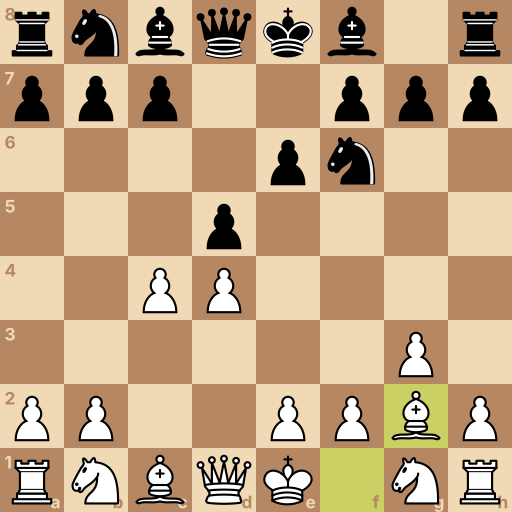
Position after 1.d4 Nf6 2.c4 e6 3.g3 d5 4.Bg2. Black to move.
These four squares are the middle of the board. A piece standing near them reaches everywhere; a piece stuck on the edge reaches half as far.
White moves first. This opening takes the middle with two pawns, then adds a bishop whose pressure never switches off.
Your move: Push your queen's pawn two squares, to d4, and take your first middle square.
1.d4 The pawn in front of your queen — two steps to d4 grabs the middle.
Your move: Their knight comes out. Push c4 — a second pawn leaning on the middle, and an offer their d-pawn will have to think about all game.
2.c4 The c-pawn, two steps — it leans on d5 next to your middle pawn.
Your move: They build with e6. Now the Catalan move: one step with your g-pawn, to g3. It looks slow — it opens the corner for the bishop that defines this opening.
3.g3 One step with the g-pawn — it opens the corner for your king's bishop.
Your move: They plant d5 in the middle. Slide your bishop to g2 — from that quiet corner it presses the long diagonal, straight through d5 toward their queenside.
4.Bg2 The king's bishop tucks into g2, onto the long diagonal.
Question: The bishop sits in a corner, staring at a wall of their pawns. What is it actually doing?
Answer: Nothing yet — it waits for the middle to loosen, then it owns the longest diagonal. Imagine their d5 pawn gone, and follow the diagonal to its end. Every trade in the middle opens the bishop's road another square — through d5, through b7, all the way to their rook's corner. They can't ever trade it off, and they can't ever fully close the road. That slow pressure is the Catalan.
This is the Catalan Opening. Two pawns in the middle, one bishop with a lifetime job.
Their most tempting try is grabbing your c-pawn. The next chapter takes it back in three moves.
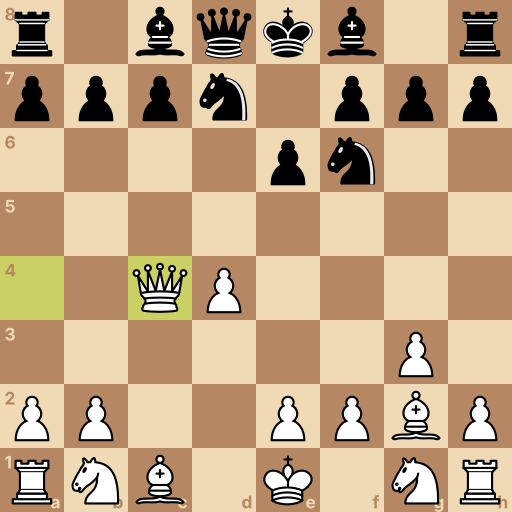
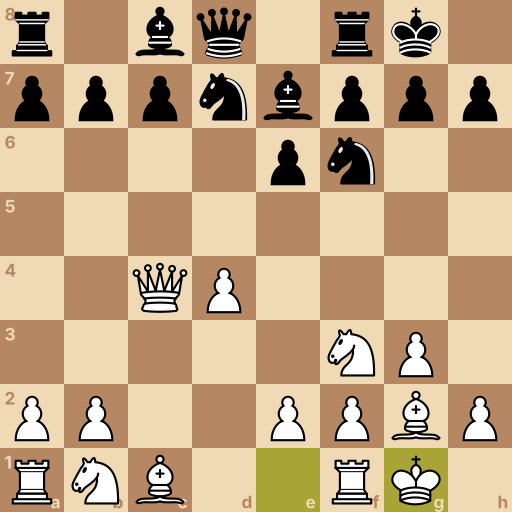
Position after 1.d4 Nf6 2.c4 e6 3.g3 d5 4.Bg2 dxc4 5.Qa4+ Nbd7 6.Qxc4. Black to move.
There it is — they grab the c-pawn. Notice what changed the moment their d5 pawn left: your g2 bishop's road just got longer.
The pawn itself never sticks. Watch your queen collect it, with a check on the way.
Your move: Swing your queen to a4, with check. Their king must be answered before anything else — which means the c4 pawn gets no help.
5.Qa4+ The queen slides to a4 — the check comes first, the pawn comes next.
Your move: They block with the knight. Now collect: queen takes the c4 pawn, and the material is even again.
6.Qxc4 The queen collects the c4 pawn — the grab lasted exactly two moves.
Question: The grab cost them nothing in material. So what did it cost?
Answer: Their middle pawn, and your bishop's diagonal is open for good. Compare their middle now to before the grab — and follow the g2 bishop's road. They traded their strong d5 pawn for a c-pawn you took straight back. The middle is theirs no longer, and the g2 bishop breathes down the open diagonal for the rest of the game. Grabs against the Catalan pay you.
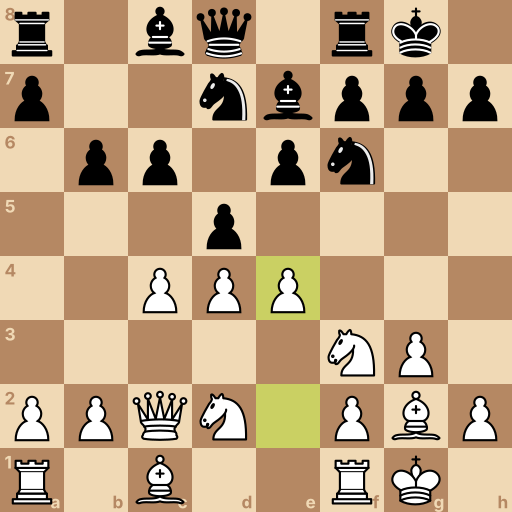
Position after 1.d4 Nf6 2.c4 e6 3.g3 d5 4.Bg2 Be7 5.Nf3 O-O 6.O-O Nbd7 7.Qc2 c6 8.Nbd2 b6 9.e4. Black to move.
When they decline the grab and just develop, so do you — knight, castle, queen, knight.
Every piece takes a square that supports one future move: the e4 break that opens the bishop's road for good.
Your move: They tuck their bishop on e7. Bring your kingside knight to f3 — toward the middle, clearing the way to castle.
5.Nf3 The knight beside your king's rook — one jump to f3.
Your move: They castle. Castle too — two squares toward the corner, king tucked behind the g2 bishop.
6.O-O Two squares toward the corner — the rook jumps over by itself.
Your move: They tuck a knight on d7. Step your queen to c2 — she guards the c-pawn, watches e4, and clears d1 for a rook.
7.Qc2 The queen steps to c2 — guarding, watching e4, clearing d1.
Your move: They seal their middle with c6. Bring your last knight to d2 — its whole job is to back up the e4 push.
8.Nbd2 The queenside knight steps to d2, behind the coming e4 push.
Your move: They develop on the side. Now the break everything was built for: push e4. Queen and knight stand behind it, and the middle starts to open — exactly what your bishop has waited for.
9.e4 The e-pawn, two steps — the break your last three moves prepared.
Question: The middle is about to trade open. Who does that favor?
Answer: You — every pawn that leaves the middle lengthens your bishop's diagonal. Ask which piece gains a square every time a middle pawn disappears. Open positions belong to the better bishop, and yours has pointed at their queenside since move four. As the middle clears, the g2 bishop and your rooks arrive together. That is the squeeze paying out.
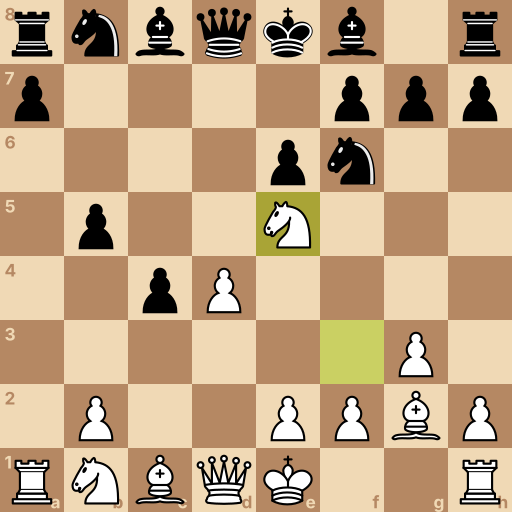
Position after 1.d4 Nf6 2.c4 e6 3.g3 d5 4.Bg2 dxc4 5.Nf3 b5 6.a4 c6 7.axb5 cxb5 8.Ne5. Black to move.
The greedy version: they grab c4, and when you develop instead of rushing, they play b5 to keep it.
Two loose pawns holding hands, far from their army. One lever move breaks the grip.
Your move: Push a4 — the lever. It attacks the b5 pawn, the one holding the whole hoard together.
6.a4 The a-pawn, two steps — it attacks b5, the base of their pawn chain.
Your move: They prop with c6. Take the b5 pawn — the props are running out.
7.axb5 Your a-pawn takes on b5 and pulls the chain apart.
Your move: They take back with the c-pawn — and look at your g2 bishop. Its diagonal now runs unblocked all the way to their rook. Jump your knight to e5 to clear the last of your own pieces off that road.
8.Ne5 The knight steps to e5, off the bishop's diagonal — and the road to a8 opens.
Question: Their rook in the corner is now staring down your bishop's open diagonal. What did the hoard really cost them?
Answer: Their whole queenside — loose pawns, an open diagonal, and a rook in trouble. Count their loose pawns, then follow the diagonal from g2 to its end. Every pawn they spent keeping the grab left another hole, and the trades opened the bishop's road all the way home. Against the Catalan, hoarding pawns means paying in squares — and squares win games.
Final challenge: The Hoarder (800 Elo)
The opponent says: Your c-pawn? Mine now. Going straight in the cheek pouch.
Your tasks in the game, in order:
Queen to a4, with check — the king comes before the pawn.
They block — now collect the c4 pawn with your queen.
Bring your kingside knight to f3.
Castle — king safe, bishop pressing, squeeze on.
Position after 1.d4 Nf6 2.c4 e6 3.g3 d5 4.Bg2 dxc4 5.Qa4+ Nbd7 6.Qxc4 Be7 7.Nf3 O-O 8.O-O. Black to move.
History of the Catalan Opening
The Catalan begins 1.d4 Nf6 2.c4 e6 3.g3 and is classified under ECO E00 to E09, with the king bishop usually developing to g2 on the long diagonal. Its name was adopted at the 1929 Barcelona tournament in Catalonia, and the opening became established in master practice during the following decades.
Main ideas for White
White combines the d4 and c4 pawns with a fianchettoed bishop on g2, controlling d5 and pressing the g2-a8 diagonal. A knight on f3 and castling secure the kingside, while a queen on c2 and the queenside knight on d2 often prepare an e4 advance. Black usually builds pawns on d5 and c6 or captures the c4 pawn, then may support it with b5; White relies on development, diagonal pressure, and timely central play.
Typical plans
Closed Catalan positions usually feature White's space on d4 and c4 against Black's pawn chain on d5, e6, and c6. White places rooks on central files, prepares the e4 break, and keeps the g2 bishop aimed at b7 and a8; Black seeks queenside activity with a c5 break, b6, or a timely capture on c4. If Black holds the extra pawn with b5, White uses a4 to break the chain and open the long diagonal.
Common mistakes
Chasing the c4 pawn before completing development can waste tempi; use a check from a4 only when the recapture is secure.
Advancing the e-pawn before enough pieces support it can lose the central pawn; prepare the break with the queen and queenside knight.
Allowing Black to secure b5 without an immediate challenge can leave the c4 pawn protected; attack the chain with the a-pawn advance.
Related openings
Queen's Gambit1.d4 d5 2.c4. Offer the c-pawn and take the middle either way.
London System1.d4 d5 2.Bf4. The same solid house nearly every game.
Trompowsky Attack1.d4 Nf6 2.Bg5. Bishop out on move two, their prep out the window.
King's Indian Defense1.d4 Nf6 2.c4 g6. Let them build the middle, then strike it down.
Slav Defense1.d4 d5 2.c4 c6. Guard the middle and keep your bishop free.
Dutch Defense1.d4 f5. Claim e4 with a wing pawn and storm their king.
Grünfeld Defense1.d4 Nf6 2.c4 g6 3.Nc3 d5. Hand them the big middle, then hammer it.
Nimzo-Indian Defense1.d4 Nf6 2.c4 e6 3.Nc3 Bb4. Pin the knight and own e4 without a pawn.