White brings the knight out first and keeps the f-pawn free to charge. You play the setup, the pawn storm, and a full game against an opponent that grabs the gambit pawn.
Start here
0
Chapter 1: The Setup
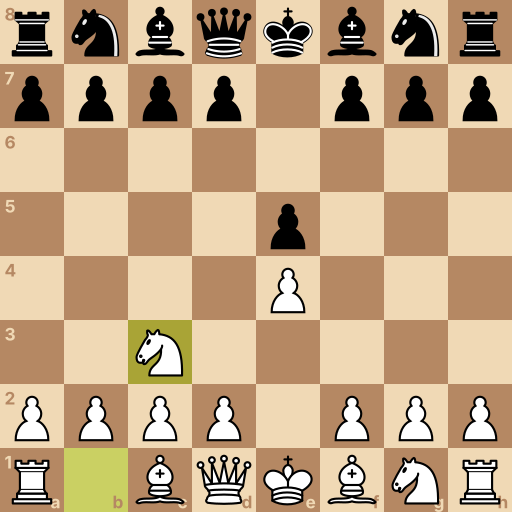
Main line: 1.e4 e5 2.Nc3
Position after 1.e4 e5 2.Nc3. Black to move.
Every opening starts as a fight over these four middle squares. A piece in the middle reaches the whole board; a piece stuck at home reaches almost nothing.
White moves first, so you take one of the four — and then guard it in a way most players never expect.
Your move: Push the pawn in front of your king two squares, to e4, and take your first middle square.
1.e4 Try the pawn in front of your king — two steps to e4 grabs the middle.
Your move: They answer with e5. Now the Vienna move — your queenside knight to c3, guarding e4 while your f-pawn stays free.
2.Nc3 Bring the knight beside your queen to c3 — it guards e4 and blocks nothing.
Question: Why the queenside knight before anything else?
Answer: It guards e4 and keeps the f-pawn's path clear. Look at what the knight touches — e4 — and what it does not block — your f-pawn. A knight on f3 would sit right in the f-pawn's way. From c3 the knight guards e4, and the f4 charge stays on the menu. That one choice is the whole Vienna.
That is the Vienna Game: a pawn in the middle, a knight guarding it, and an f-pawn ready to storm.
They usually bring a knight to f6. Some copy yours to c6, and some rush a bishop out early. You will learn all three.
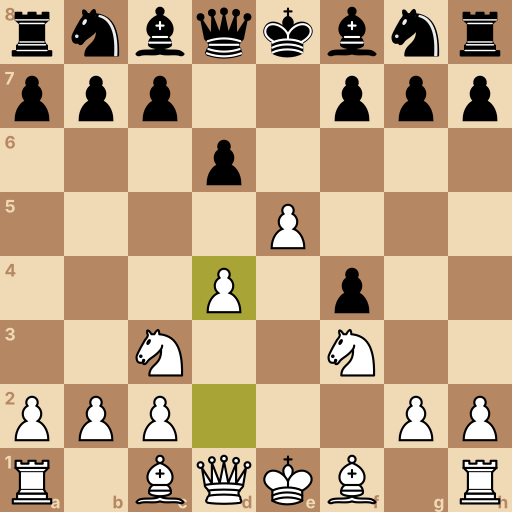
Position after 1.e4 e5 2.Nc3 Nf6 3.f4 exf4 4.e5 Ng8 5.Nf3 d6 6.d4. Black to move.
Their knight eyes your e4 pawn, but your c3 knight already has it covered.
Now the move they never see coming: the f-pawn charges and offers itself, just to break their grip on the middle.
Your move: Launch the storm — push your f-pawn two squares to f4, straight at their middle pawn.
3.f4 Two steps to f4 — the charge is the whole point of the Vienna.
Your move: They take the pawn. Now your middle pawn charges — push e5 and hit their knight, which has to run.
4.e5 Push e5 — it attacks their knight, and the knight has nowhere good to go.
Your move: The knight runs all the way home to g8. Develop yours to f3 — and note it covers h4, so their queen can never land there with check.
5.Nf3 Knight to f3 — it develops and shuts the h4 check square.
Your move: They poke at your e5 pawn with d6. Build the big middle — push your d-pawn two squares to d4.
6.d4 Pawn to d4 — two pawns abreast in the middle, both defended.
Question: They are a pawn up. Why are you happy?
Answer: Your pawns own the middle and their knight went home. Count space and development, not pawns — their knight is on g8 again. One pawn bought you the whole middle, a lead in development, and a knight that has to start over. That trade wins games at every level.
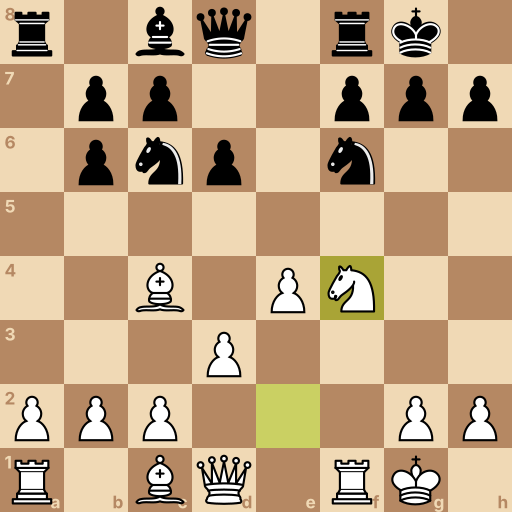
Position after 1.e4 e5 2.Nc3 Nc6 3.Bc4 Bc5 4.d3 d6 5.Na4 Bb6 6.Nxb6 axb6 7.Ne2 Nf6 8.O-O O-O 9.f4 exf4 10.Nxf4. Black to move.
They copy your knight. Fine — your bishop takes the diagonal that points at f7, and the f-pawn charge stays on the menu.
One piece will try to spoil the storm: their mirror bishop, aiming at the corner where your king will live. This chapter hunts it down first, then charges.
Your move: Bring your bishop out to c4, where its diagonal runs all the way to f7.
3.Bc4 Slide the bishop to c4 — it points straight at f7.
Your move: They mirror your bishop to c5 — and now it glares at the corner your king wants. Push your d-pawn one square to d3 first, propping e4.
4.d3 One small step — d3 guards e4 and frees your dark bishop.
Your move: They prop e5 with d6. Now hunt the mirror bishop — knight to a4, offering a trade it cannot really avoid.
5.Na4 Knight to a4 — it attacks the c5 bishop, and running only delays the trade.
Your move: The bishop hides on b6, but your knight reaches it there too. Take it.
6.Nxb6 Knight takes on b6 — the hunt is over.
Your move: Their a-pawn takes back, and their rook gets an open file — a fair price for the piece that guarded your king's corner. Bring your knight to e2, keeping the f-road clear.
7.Ne2 Knight to e2 — f3 would sit in the f-pawn's way.
Your move: Their knight comes to f6. Castle — with the mirror bishop gone, the corner is truly safe.
8.O-O Castle — slide your king two squares right, and the rook lines up behind the f-pawn.
Your move: They castle too. Now the storm — push your f-pawn two squares to f4, with your rook right behind it.
9.f4 There it is — f4 charges the middle, king safe, rook behind it.
Your move: They take on f4. Take back with your e2 knight — that was its whole job, and it lands on a beautiful square.
10.Nxf4 Knight takes on f4 — the e2 knight was waiting for exactly this.
Question: So what did the copy get them?
Answer: A cramped game — the storm arrived anyway, with backup. The storm landed with every piece behind it — copying stopped nothing. Their best bishop is off the board, your rook stares down the half-open f-file, and your knight sits proud on f4. The storm came anyway — just better prepared.
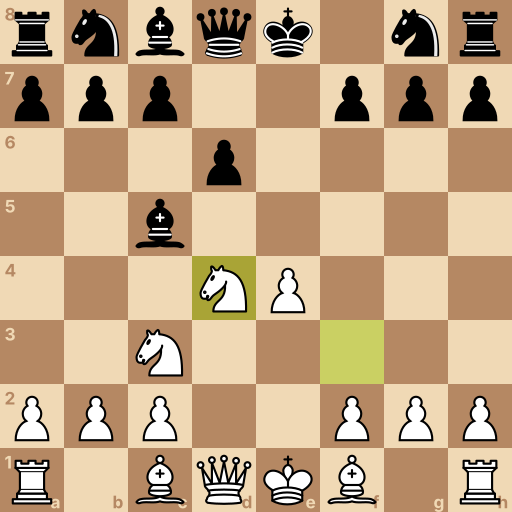
Position after 1.e4 e5 2.Nc3 Bc5 3.Nf3 d6 4.d4 exd4 5.Nxd4. Black to move.
The bishop rushes out before any knight — and leaves their e5 pawn with no guard at all.
Punish the hurry the calm way: develop with threats, and make every move cost them something.
Your move: Bring your knight to f3 — it develops and attacks the unguarded e5 pawn at the same time.
3.Nf3 Knight to f3 — a developing move that carries a threat.
Your move: They scramble back with d6 to guard the pawn. Hit the middle — push your d-pawn two squares to d4.
4.d4 Pawn to d4 — it attacks e5 again and pokes their bishop's diagonal open.
Your move: They trade pawns on d4. Take back with your knight, landing it in the middle of the board.
5.Nxd4 Knight takes on d4 — recapture and centralize in one move.
Question: So how do you punish the early bishop?
Answer: Develop with threats until you own the middle. Every developing move of yours carried a threat — that is the tax on their hurry. Knight out with a threat, pawn break with a threat, knight to the middle. They spent their opening on one bishop; you spent it on the whole board.
Final challenge: The Snatcher (800 Elo)
The opponent says: A free pawn on f4? Don't mind if I do.
Your tasks in the game, in order:
Launch the storm — push your f-pawn two squares to f4.
They snatched it. Push e5 and send their knight running.
Bring your knight to f3, covering the h4 check square.
Claim the whole middle with pawn to d4.
Position after 1.e4 e5 2.Nc3 Nf6 3.f4 exf4 4.e5 Ng8 5.Nf3 d6 6.d4. Black to move.
History of the Vienna Game
The Vienna Game begins 1.e4 e5 2.Nc3 and is classified under ECO C25 through C29. Its name comes from the Viennese players who developed and promoted its theory during the nineteenth century. It became an established alternative to 2.Nf3 in nineteenth-century tournament play.
Main ideas for White
White develops the queenside knight to c3, where it protects e4 and controls d5 and b5 without blocking the f-pawn. The move f4 can challenge e5 directly and create a Vienna Gambit after 2...Nf6 3.f4. White also develops the bishop to c4 along the f7 diagonal and may use d3 before castling. Black usually attacks e4 with Nf6, develops with Nc6, or places the bishop on c5.
Typical plans
After f4 and exf4, White often advances e5, develops Nf3, and builds a broad center with d4 while Black tries to challenge that center with d6 or d5. Quieter structures use d3, Bc4, and O-O before the f4 break. White seeks kingside activity and use of the half-open f-file, while Black looks for central counterplay and pressure on e4. The main White breaks are f4 and d4.
Common mistakes
Do not block the f-pawn with an early Nf3 when planning the Vienna Gambit; develop Nc3 first and choose the right moment for f4.
Do not push f4 without watching king safety and central tactics; develop quickly and answer an accepted gambit with active central play.
Do not chase the c5 bishop with several pawns; develop with threats against e5 and use d4 to contest the center.
Related openings
Italian Game1.e4 e5 2.Nf3 Nc6 3.Bc4. Fast pieces, and a bishop aimed straight at f7.
Ruy Lopez1.e4 e5 2.Nf3 Nc6 3.Bb5. Lean on the one knight holding up their middle.
King's Gambit1.e4 e5 2.f4. Spend a pawn, own the middle and an open file.
Scotch Game1.e4 e5 2.Nf3 Nc6 3.d4. Break the middle open on move three.
Caro-Kann Defense1.e4 c6. Answer 1.e4 with a middle pawn that arrives guarded.
French Defense1.e4 e6. One pawn guards, the next one strikes the middle.