One pawn guards before the other strikes — e6 then d5 gives you a middle pawn White cannot chase away. You play the setup, both replies, and a full game against an opponent that builds a pawn wall across the middle.
Start here
0
Chapter 1: Prepare, Then Strike
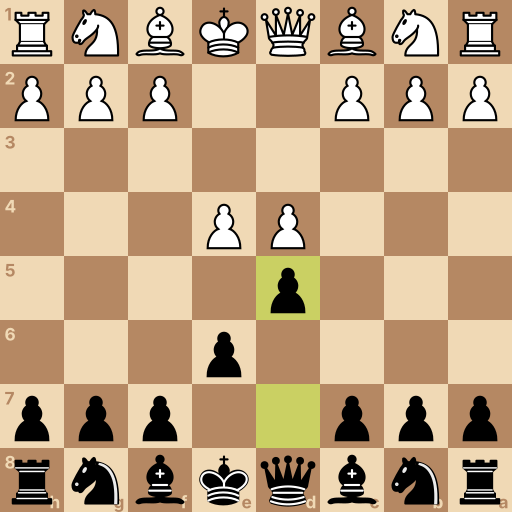
Main line: 1.e4 e6 2.d4 d5
Position after 1.e4 e6 2.d4 d5. White to move.
A piece in the middle can reach the whole board in a move or two, and a piece on the edge can't. Both players want these four squares.
White moves first, so they will grab one before you can. Your opening is about striking back at that grab with support already in place.
There it is: 1.e4, the most common first move in chess. Their pawn takes a middle square and opens lines for their queen and bishop.
The French Defense does not argue with it head-on. It sets a guard on d5 first, then strikes there a move later.
Your move: Push your king's pawn one square, to e6. Its one job: guard the d5 square before your pawn strikes there.
1...e6 Just one step — the king's pawn to e6 sets the guard on d5.
Your move: They grab the other middle square with d4. Now strike — push your queen's pawn two squares to d5, attacking their e4 pawn.
2...d5 Now the strike — two squares to d5, straight at their e4 pawn.
Question: Your d5 pawn attacks their e4 pawn. Why is that safe for you?
Answer: If they take, the e6 pawn takes back. Look at who guards d5 the moment their pawn takes it. If they take on d5, your e-pawn recaptures and you keep a pawn in the middle. That trade is the next chapter.
This is the French Defense. Your d5 pawn arrived guarded, and their e4 pawn must decide what to do about it.
One cost is honest: your c8-bishop starts behind the e6 pawn. Watch how each reply gives it a way out — or a job at home. They can take on d5, or push past to e5.
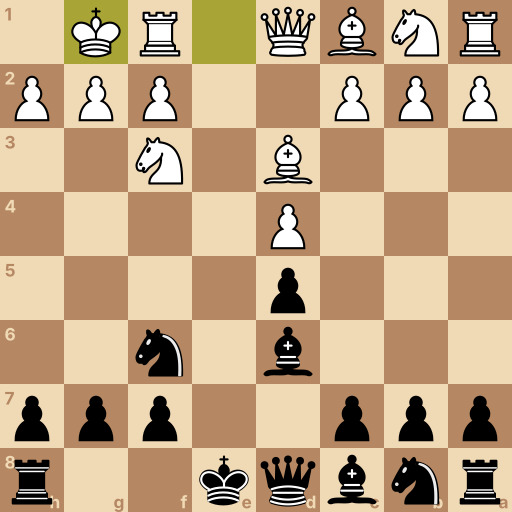
Position after 1.e4 e6 2.d4 d5 3.exd5 exd5 4.Nf3 Bd6 5.Bd3 Nf6 6.O-O. Black to move.
They took. Recapture with your e-pawn and something good happens: the e6 pawn that shut in your c8-bishop is about to disappear.
Your move: Take their pawn on d5 with your e-pawn, toward the middle. You keep a pawn there, and your c8-bishop's diagonal is suddenly open.
3...exd5 Take back with the e-pawn — it keeps a pawn in the middle and frees your bishop.
Your move: They bring a knight to f3. Put your dark bishop on d6, the active square where it points at their kingside.
4...Bd6 The dark bishop to d6 — from there it stares at their kingside.
Your move: They mirror your bishop. Bring your knight to f6 — its best square, watching e4 and clearing the way to castle.
5...Nf6 The knight to f6 — its favorite square, and your king can castle after it.
Question: The position is a mirror. What decides it?
Answer: Whoever finishes development first. No tricks live in a mirror — the race is development. Even pawns, open lines for both sides. Castle next, connect the rooks, and the better-developed side gets to ask the questions.
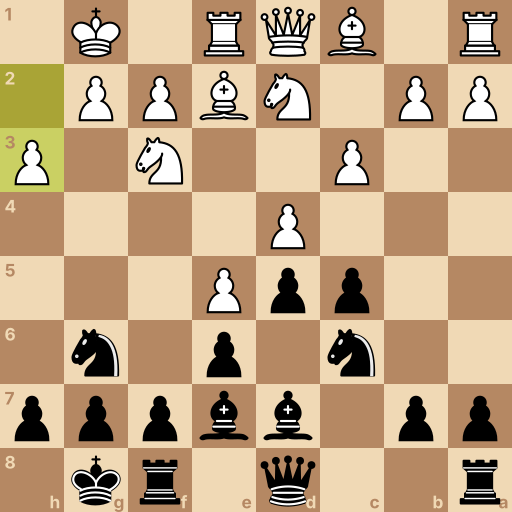
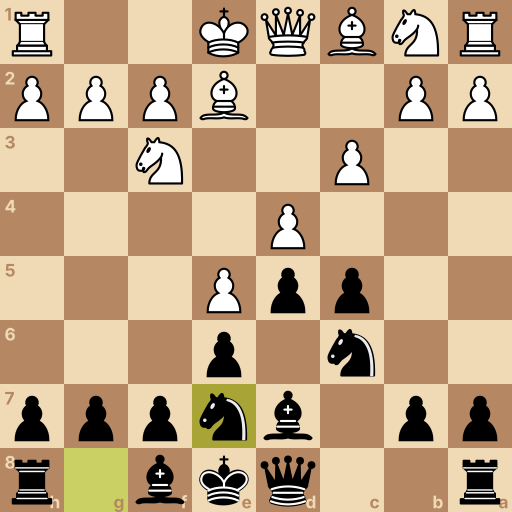
Position after 1.e4 e6 2.d4 d5 3.e5 c5 4.c3 Nc6 5.Nf3 Bd7 6.Be2 Nge7 7.O-O Ng6 8.Re1 Be7 9.Nbd2 O-O 10.h3. Black to move.
Instead of taking, they push past and build a pawn wall from d4 to e5. Your kingside knight loses the f6 square, and the middle locks.
A locked wall has a base. Theirs is d4, and your whole plan is to knock on it.
Your move: Knock at the base of their wall at once — push your c-pawn two squares to c5, attacking d4.
3...c5 The wall's base is d4 — knock on it with your c-pawn, two steps.
Your move: They prop up d4 with a small pawn move. Add a second attacker — your queenside knight to c6.
4...Nc6 Bring the knight beside your rook to c6 — a second hand knocking on d4.
Your move: Their knight guards d4 too. Slide your light bishop one step to d7 — it guards your c6 knight and clears the back rank behind it.
5...Bd7 One quiet step to d7 — the bishop guards your knight from there.
Your move: Their bishop steps out. Your kingside knight cannot use f6 — their pawn owns it — so send it out through e7, on its way to g6 or f5.
6...Nge7 f6 belongs to their pawn — take the sideways door through e7.
Your move: They castle. Hop the knight on to g6, where it eyes the front of their wall and clears the path for your dark bishop.
7...Ng6 One more hop, to g6 — the knight watches e5 from there.
Your move: Their rook slides to the middle. Bring your dark bishop to e7 — the last piece between your king and castling.
8...Be7 The dark bishop to e7 — it clears the way for your king.
Your move: Everything is placed. Castle — slide your king two squares toward the corner.
9...O-O Time to castle — two squares toward the corner.
Question: The wall still stands. Where does your play come from?
Answer: Keep piling on d4, the base of the wall. The wall hangs from d4 — keep adding attackers there. Every attacker on d4 ties one of their pieces to defense. Trades there open the c-file for your rooks, and if the base ever falls, the whole wall goes with it.
Chapter 4: The Small Game
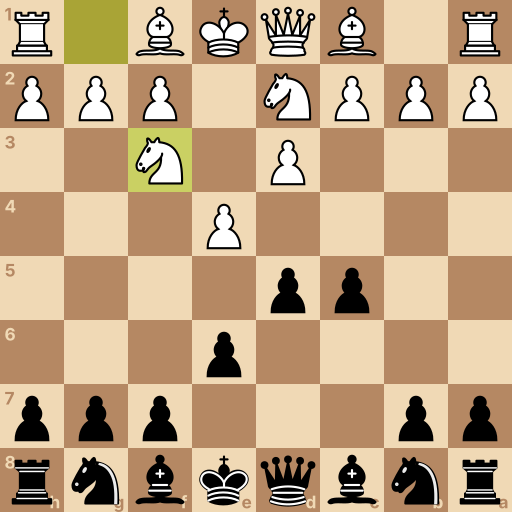
Main line: 1.e4 e6 2.d3 d5 3.Nd2 c5 4.Ngf3
Position after 1.e4 e6 2.d3 d5 3.Nd2 c5 4.Ngf3. Black to move.
Sometimes they tuck a pawn on d3 and skip the second middle square. Nothing to strike at — but nothing in your way either.
When they play small, you take more ground than the opening usually gives you.
Your move: Claim d5, guarded by e6 as always. Their small pawn cannot fight for it.
2...d5 Same strike as always — two squares to d5, into the guarded spot.
Your move: Their knight tucks in behind the pawns. Spread out — push your c-pawn two squares to c5 and take ground their pawns cannot argue about.
3...c5 Go wide — two squares to c5 claims more ground for free.
Question: You hold more ground than they do. What now?
Answer: Develop behind your pawns and castle. Ground only counts with pieces behind it — develop and castle. Your pawns cramp them the way White's pawns usually cramp you. Pieces out behind them, castle, and push again only when a pawn is chased.
Final challenge: The Wall (800 Elo)
The opponent says: I build my wall across the middle. Knock all you like.
Your tasks in the game, in order:
Knock at the wall's base — push your c-pawn to c5.
Add a second attacker on d4 with your knight to c6.
Slide your light bishop to d7, guarding the knight.
Step your kingside knight out to e7 — f6 belongs to their pawn.
Position after 1.e4 e6 2.d4 d5 3.e5 c5 4.c3 Nc6 5.Nf3 Bd7 6.Be2 Nge7. White to move.
History of the French Defense
The French Defense begins with 1.e4 e6 2.d4 d5 and covers ECO codes C00 through C19. Its name comes from an 1834 correspondence match between clubs in London and Paris, where the Paris team used the defense. The opening became established in tournament practice during the later nineteenth century.
Main ideas for Black
Black uses 1...e6 to support 2...d5, challenging e4 and building a firm central chain. The cost is that e6 restricts the bishop on c8, so Black must find it a role or free it through exchanges. After the Advance 3.e5, 3...c5 attacks d4, and the knight from b8 often joins on c6. White usually maintains d4-e5 space, supports the base with c3, and seeks kingside activity.
Typical plans
In the Advance structure, White pawns on d4 and e5 face Black pawns on e6, d5, and c5, creating a locked center with queenside pressure on d4. Black piles pieces against that base, exchanges on d4 when favorable, and uses the c-file for rooks. White generally seeks kingside space and supports the center. In Exchange positions, open lines make development and king safety more important than attacks on a fixed pawn chain.
Common mistakes
Playing 3...Nf6 after 3.e5 puts the knight on a square the e5 pawn attacks and loses it to 4.exf6, so develop the knight through e7 instead.
Delaying 3...c5 lets White secure d4, so challenge the pawn chain immediately after the Advance closes the center.
Treating the c8 bishop as useless wastes a defender, so develop it to d7 or free its diagonal through central exchanges.
Related openings
Caro-Kann Defense1.e4 c6. Answer 1.e4 with a middle pawn that arrives guarded.